Wilt Chamberlain Biography: The Most Physically Dominant Player in NBA History
Who Is Wilt Chamberlain?
Wilt Chamberlain, born on August 21, 1940, in Philadelphia, Pennsylvania, and passing away on October 12, 1999, was an American basketball player widely regarded as one of the greatest and most dominant players in NBA history. Standing at 7 feet 1 inch, his imposing physical presence and unparalleled athleticism allowed him to redefine the center position and shatter numerous scoring and rebounding records that stand to this day. His career was marked by incredible individual achievements, including two NBA championships, four MVP awards, and an astonishing 100-point game.
Early Life: Philadelphia and Growing Pains
Chamberlain's early life in Philadelphia was characterized by his rapid growth, which initially made him feel awkward and self-conscious. He attended Overbrook High School, where he quickly became a basketball sensation, leading his team to three public school championships and compiling an impressive 56-3 record over three seasons. His dominance was evident even then, as he often scored over 50 points in high school games, attracting national attention and making him one of the most sought-after recruits in the country.
University of Kansas
Despite being heavily recruited by numerous colleges, Chamberlain chose to attend the University of Kansas. During his time with the Jayhawks, he continued his record-breaking ways, averaging 29.9 points and 18.3 rebounds per game over two varsity seasons. In his sophomore year (1956-57), he led Kansas to the NCAA championship game, where they narrowly lost to the North Carolina Tar Heels in triple overtime. His collegiate career was so dominant that the NCAA implemented rules changes, including widening the lane and instituting offensive goaltending, largely in response to his overwhelming presence.
Harlem Globetrotters Year
After his junior year at Kansas, Chamberlain decided to leave college early, but due to NBA rules at the time, he was not eligible to play until his college class graduated. To bridge this gap, he spent the 1958-59 season playing for the Harlem Globetrotters. This experience allowed him to hone his skills, travel the world, and develop a more diverse offensive repertoire, preparing him for his eventual entry into the NBA.
Philadelphia Warriors and the 100-Point Game
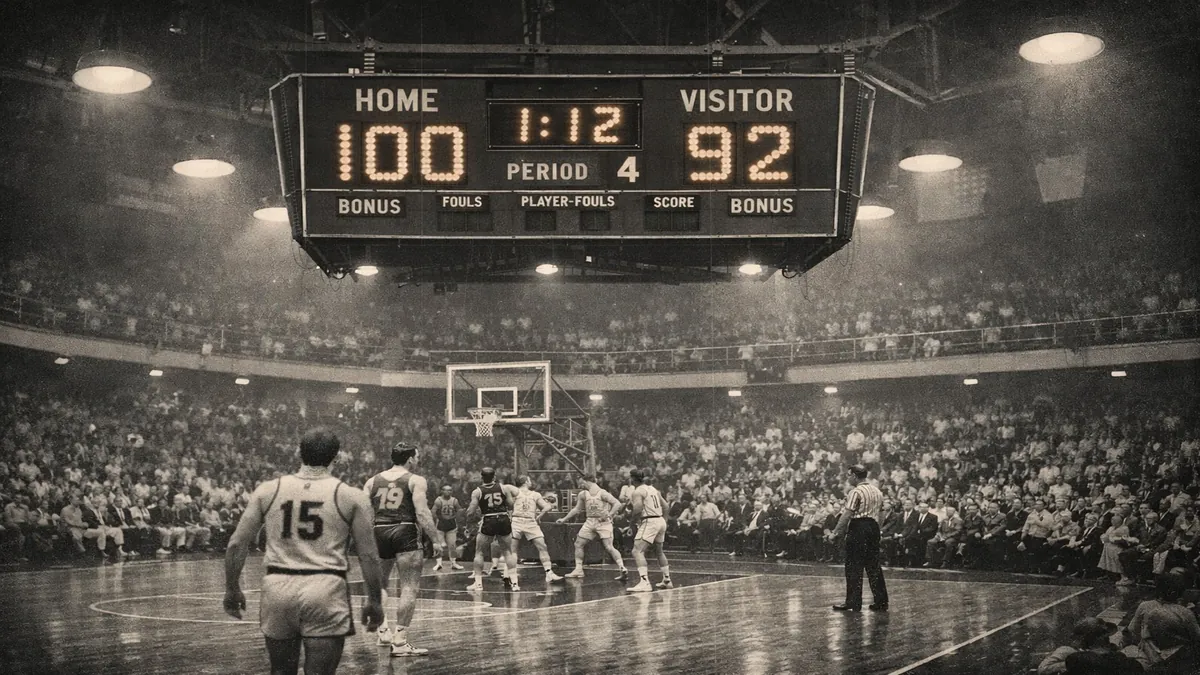
Chamberlain made his NBA debut with the Philadelphia Warriors in 1959, immediately making an impact. He averaged an incredible 37.6 points and 27.0 rebounds per game in his rookie season, earning both Rookie of the Year and MVP honors. His most iconic performance came on March 2, 1962, when he scored an unprecedented 100 points against the New York Knicks in Hershey, Pennsylvania. This single-game scoring record remains unbroken and is a testament to his offensive prowess.
The Statistical Seasons Nobody Has Approached
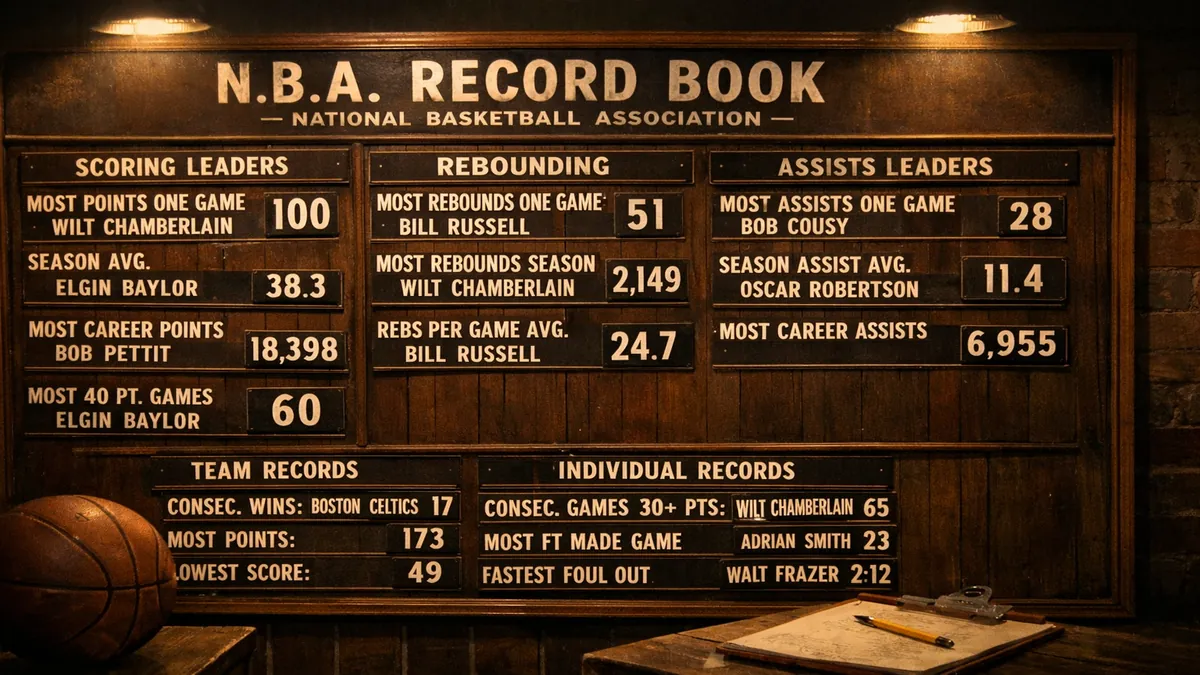
Beyond the 100-point game, Chamberlain's early career was filled with statistical anomalies that have never been replicated. In the 1961-62 season, he averaged an astounding 50.4 points and 25.7 rebounds per game, playing an average of 48.5 minutes per game (meaning he rarely left the court, even in overtime games). He also holds the record for the most rebounds in a single game (55) and the highest career rebounding average (22.9 RPG). His statistical dominance during this era is unmatched.
San Francisco Warriors and 76ers Championships
In 1962, the Warriors franchise moved to San Francisco, and Chamberlain continued his dominant play. However, team success eluded him until he was traded back to Philadelphia to play for the 76ers in 1965. With the 76ers, he finally broke through, leading them to an NBA championship in 1967, defeating his perennial rival Bill Russell and the Boston Celtics. This championship was particularly significant as it ended Boston's eight-year reign.
Los Angeles Lakers: The Finals That Got Away
Chamberlain was traded to the Los Angeles Lakers in 1968, forming a super team with Jerry West and Elgin Baylor. Despite reaching the NBA Finals multiple times, they often fell short against the Celtics. However, in 1972, with a more balanced team and a focus on defense, Chamberlain led the Lakers to a then-record 33-game winning streak and ultimately their first NBA championship in Los Angeles. He was named the Finals MVP for his dominant performance.
Wilt vs Bill Russell: The Greatest Rivalry
The rivalry between Wilt Chamberlain and Bill Russell is one of the most storied in sports history. While Chamberlain often dominated Russell statistically, Russell's Celtics consistently got the better of Chamberlain's teams in the playoffs, leading to Russell's eleven championships compared to Chamberlain's two. This rivalry fueled intense debates about individual brilliance versus team success and remains a classic example of two titans clashing.
Career Statistics Overview
| Statistic | Value | |||
|---|---|---|---|---|
| Career PPG | 30.1 | |||
| Career RPG | 22.9 | |||
| Career APG | 4.4 | |||
| Career FG% | 54.0% | |||
| Career Games | 1,045 | |||
| Career Points | 31,419 | |||
| Career Rebounds | 23,924 | |||
| Season | Team | PPG | RPG | FG% |
| 1959-60 | Philadelphia Warriors | 37.6 | 27.0 | 46.1% |
| 1961-62 | Philadelphia Warriors | 50.4 | 25.7 | 50.9% |
| 1962-63 | San Francisco Warriors | 44.8 | 24.3 | 52.8% |
| 1966-67 | Philadelphia 76ers | 24.1 | 24.2 | 68.3% |
| 1971-72 | Los Angeles Lakers | 14.8 | 19.2 | 64.9% |
| Career | 30.1 | 22.9 | 54.0% |
His career field goal percentage of 54.0% is remarkable given that he was taking the majority of shots from close range against elite defensive centers. His 23,924 career rebounds remain the all-time record by a margin so large that it will never be approached in the modern game. No active player is within 8,000 rebounds of his total.
The 1967 Philadelphia 76ers: The Team That Stopped the Celtics
The defining team achievement of Wilt Chamberlain's career came in the 1966-67 season with the Philadelphia 76ers. Tired of being blamed for his inability to win championships against Russell's Celtics, Chamberlain transformed his game. He cut his scoring from 33.5 to 24.1 points per game and increased his assists from 4.4 to 7.8 — demonstrating that his dominant scoring was a choice rather than a compulsion.
The result was a 76ers team that went 68-13 — then the best record in NBA history — and won the championship over the San Francisco Warriors. They ended the Celtics' dynasty in the process, defeating Boston in the Eastern Conference Finals.
For one season, Chamberlain produced the most statistically complete performance of any center in NBA history: 24.1 points, 24.2 rebounds, 7.8 assists, and the league's best field goal percentage. It was the proof that he could subordinate his individual statistics to the needs of a team and still dominate — a proof that arrived too late to change the championship narrative that had been established against Russell's Celtics.
Physical Dominance: The Numbers in Context
Wilt Chamberlain's physical specifications relative to his era are almost impossible to fully communicate. He stood 7'1" and weighed 275 pounds with a wingspan that exceeded 7'8". In the early 1960s, when the average NBA center stood approximately 6'8" and weighed 220 pounds, Chamberlain's physical advantages were more extreme than any player in the history of team sports has ever enjoyed relative to the competition he faced.
The most revealing statistic: Chamberlain never fouled out of a game in 1,045 career NBA regular season and playoff appearances. For a player of his size and physical dominance, who played in an era of much more physical contact than the modern game allows, this is almost inconceivable. It suggests a combination of physical control and defensive positioning that his critics — who focused on his scoring dominance — routinely overlooked.
The Final Legacy: Unstoppable Force Meets Immovable Dynasty
Wilt Chamberlain's basketball legacy is permanently complicated by his championship record — two rings against Bill Russell's eleven. This comparison has defined how Chamberlain is discussed for sixty years, and it is both illuminating and unfair in equal measure.
What the comparison reveals: Russell's teams were better constructed for winning championships. They had depth, coaching, and system that maximized every player's contribution. Chamberlain's teams were often built around maximizing his individual contributions rather than around the system that would have given those contributions the best chance of producing championships.
What the comparison obscures: the statistical evidence that Chamberlain was almost certainly the more physically dominant and individually gifted player. His career averages — 30.1 points and 22.9 rebounds per game — are so far beyond anything Russell produced that direct comparison of individual merit is impossible. Different roles, different systems, different supporting casts produced different results, and the championship count reflects team construction as much as individual excellence.
The 100-point game, the 50.4 scoring average, the 23,924 career rebounds — these are the numbers by which Wilt Chamberlain should be remembered. They represent achievements that were not simply unprecedented when they occurred but remain so completely beyond what any subsequent player has approached that they will almost certainly never be replicated. Wilt Chamberlain was the most physically dominant player in the history of professional basketball, and his statistical legacy is the most extraordinary ever compiled by a single player at any position.