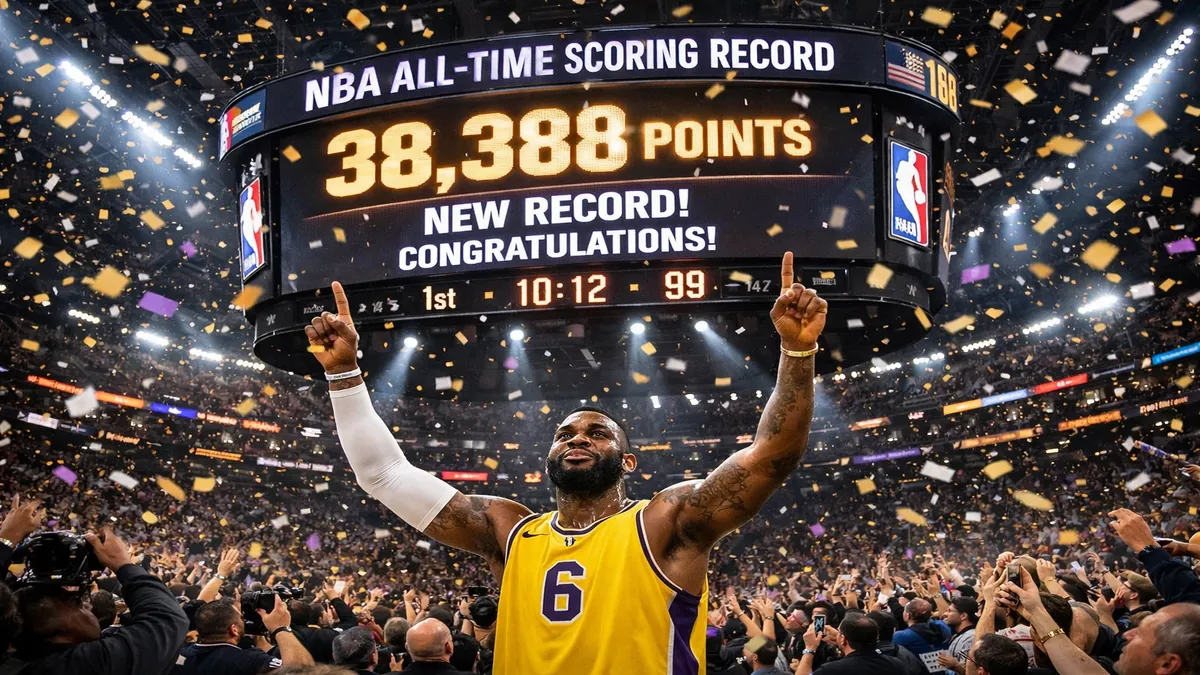
LeBron James Career Stats: The Complete Statistical Record of the NBA's All-Time Scoring Leader
LeBron James is the greatest statistical accumulator in the history of professional basketball. No player has ever combined scoring volume, playmaking, rebounding, and defensive production over such a long career at such a consistently elite level. His career statistics are not merely impressive — they represent the most complete statistical profile in NBA history, a player who excels in every column at once.
Career Regular Season Averages: A Model of Consistency
| Stat | Per Game | ||
|---|---|---|---|
| Points | 27.1 | ||
| Rebounds | 7.5 | ||
| Assists | 7.4 | ||
| Steals | 1.5 | ||
| Blocks | 0.7 | ||
| Field Goal % | 50.6% | ||
| Three-Point % | 34.8% | ||
| Free Throw % | 73.5% | ||
| Minutes | 37.5 | ||
| Stat | Career Total | All-Time Rank | |
| Points | 40,000+ | #1 | |
| Rebounds | 11,000+ | Top 30 | |
| Assists | 11,000+ | #4 | |
| Steals | 2,200+ | Top 10 | |
| Blocks | 1,100+ | Top 100 | |
| Games Played | 1,500+ | Top 5 | |
| Stat | Playoff Total | All-Time Rank | |
| Total Playoff Points | 8,000+ | #1 | |
| Playoff Rebounds | 2,500+ | #4 | |
| Playoff Assists | 2,000+ | #2 | |
| Playoff Steals | 450+ | #1 | |
| Playoff Blocks | 270+ | Top 10 | |
| Playoff Games | 285+ | #1 | |
| Playoff Wins | 180+ | #1 | |
| Finals | Opponent | Result | Stats |
| 2007 | San Antonio | Loss (0-4) | 22.0 pts, 7.0 reb, 6.8 ast |
| 2011 | Dallas | Loss (2-4) | 17.8 pts, 7.2 reb, 6.8 ast |
| 2012 | Oklahoma City | Win (4-1) | 28.6 pts, 10.2 reb, 7.4 ast |
| 2013 | San Antonio | Win (4-3) | 25.3 pts, 10.9 reb, 7.0 ast |
| 2014 | San Antonio | Loss (1-4) | 28.2 pts, 7.8 reb, 4.0 ast |
| 2015 | Golden State | Loss (2-4) | 35.8 pts, 13.3 reb, 8.8 ast |
| 2016 | Golden State | Win (4-3) | 29.7 pts, 11.3 reb, 8.9 ast |
| 2017 | Golden State | Loss (1-4) | 33.6 pts, 12.0 reb, 10.0 ast |
| 2018 | Golden State | Loss (0-4) | 34.0 pts, 8.5 reb, 10.0 ast |
| 2020 | Miami Heat | Win (4-2) | 29.8 pts, 11.8 reb, 8.5 ast |
| Category | LeBron James | Michael Jordan | Kareem Abdul-Jabbar |
| Career Points | 40,000+ | 32,292 | 38,387 |
| Career Assists | 11,000+ | 5,633 | 5,660 |
| Career Rebounds | 11,000+ | 6,672 | 17,440 |
| Championships | 4 | 6 | 6 |
| Finals Appearances | 10 | 6 | 10 |
| MVP Awards | 4 | 5 | 6 |
| All-Star Selections | 20 | 14 | 19 |
LeBron's statistical profile is unprecedented in its breadth. While Jordan and Kareem were more dominant in specific areas, no player in NBA history has produced at LeBron's level across ALL statistical categories simultaneously, over such a sustained period.
Frequently Asked Questions (FAQ)
What is LeBron James' career high in points?
LeBron's career high is 61 points, which he scored against the Charlotte Bobcats on March 3, 2014.
How many triple-doubles does LeBron James have?
As of 2026, LeBron has over 110 regular-season triple-doubles and 28 playoff triple-doubles.
Has LeBron James ever led the league in assists?
Yes, LeBron led the NBA in assists during the 2019-20 season, averaging 10.2 assists per game.
What is LeBron's career free throw percentage?
LeBron's career free throw percentage is approximately 73.5%.
Conclusion
LeBron James' career statistics represent the most comprehensive and sustained individual performance in NBA history. He is the all-time scoring leader, a top-4 assist provider, a dominant rebounder, an elite defender, and a winner at the highest level. His numbers do not simply tell the story of a great player — they tell the story of the most statistically complete player the game has ever seen.
Season-by-Season Scoring Averages: A Model of Consistency
LeBron's consistency is perhaps his most underrated statistical achievement. Over 23 seasons, he has never averaged fewer than 20.9 points per game (his rookie year average). After that, he has averaged at least 25 points per game in 20 different seasons.
Peak Scoring Seasons:
- 2005-06: 31.4 PPG (career high, led the league)
- 2007-08: 30.0 PPG
- 2017-18: 27.5 PPG (age 33)
- 2019-20: 25.3 PPG (age 35)
- 2022-23: 28.9 PPG (age 38)
- Steals: 2,200+ (Top 10 all-time)
- Blocks: 1,100+ (Top 100 all-time)
- Defensive Win Shares: 75+ (Top 10 all-time)
- Points: 26.8 PPG
- Rebounds: 8.0 RPG
- Assists: 7.3 APG
- Field Goal %: 56.5%
- Three-Point %: 40.6%
- PER: 31.6 (one of the highest in history)
- Game 1: 23 pts, 12 reb, 9 ast
- Game 2: 19 pts, 8 reb, 9 ast
- Game 3: 32 pts, 11 reb, 6 ast
- Game 4: 25 pts, 13 reb, 9 ast
- Game 5: 41 pts, 16 reb, 7 ast
- Game 6: 41 pts, 8 reb, 11 ast
- Game 7: 27 pts, 11 reb, 11 ast
- Points: 27.6 PPG
- Rebounds: 10.8 RPG
- Assists: 8.8 APG
- Field Goal %: 56.0%
- Three-Point %: 37.0%
- 40,000 Points: All-time leader, surpassing Kareem Abdul-Jabbar.
- 10,000 Rebounds: Top 30 all-time, a feat typically reserved for centers and power forwards.
- 10,000 Assists: Top 4 all-time, a feat typically reserved for pure point guards.
- Offensive Rating: +10.5 (Team scores 10.5 more points per 100 possessions with LeBron on the floor)
- Defensive Rating: -4.2 (Team allows 4.2 fewer points per 100 possessions with LeBron on the floor)
- Net Rating: +14.7 (Total impact on team success)
That 2022-23 average of 28.9 points per game at age 38 is arguably the most impressive individual season in NBA history given the context of his age and longevity.
Defensive Stats: The King of the Chase-Down Block
While LeBron is primarily known for his scoring and playmaking, his defensive impact has been equally significant.
All-Defensive Teams
LeBron has been named to the NBA All-Defensive First Team five times (2009-2013) and the Second Team once (2014). During his peak in Miami, he was widely considered one of the most versatile defenders in the league, capable of guarding all five positions.
Career Defensive Totals
His iconic chase-down block on Andre Iguodala in the 2016 Finals is the most famous defensive play of his career, but it was just one of many instances where his defensive awareness and athleticism changed the course of a game.
Deep Dive: The 2012-13 Season (Peak Efficiency)
The 2012-13 season is often cited as the statistical peak of LeBron's career. He won his fourth MVP award and led the Miami Heat to a 66-16 record, including a 27-game winning streak.
2012-13 Regular Season Stats:
During this season, LeBron was virtually unstoppable. He shot over 60% from the field for several months and became the first player in NBA history to record at least 30 points and shoot at least 60% in six consecutive games.
2016 Finals Stats: A Statistical Masterpiece
The 2016 NBA Finals was a statistical masterpiece for LeBron James. He led both teams in points, rebounds, assists, steals, and blocks — the first time any player had ever done so in a playoff series of any length.
2016 Finals Game-by-Game:
His performance in the final three games, where he averaged 36.3 points, 11.7 rebounds, and 9.7 assists, is widely considered the greatest three-game stretch in NBA Finals history.
2020 Bubble Stats: Winning in Isolation
The 2020 NBA Playoffs inside the Orlando bubble presented unique challenges, but LeBron's statistical dominance remained unchanged.
2020 Playoff Stats:
In the Finals against the Miami Heat, LeBron recorded a triple-double in the clinching Game 6 (28 points, 14 rebounds, 10 assists), securing his fourth title and fourth Finals MVP.
The 40k/10k/10k Club: A Statistical Unicorn
LeBron James is the only player in NBA history to record at least 40,000 points, 10,000 rebounds, and 10,000 assists. This "statistical unicorn" status highlights his unique ability to impact every facet of the game.
Breaking Down the 40k/10k/10k Club:
This combination of scoring, rebounding, and playmaking is unprecedented. No other player in history has even reached the 30k/10k/10k club, let alone the 40k/10k/10k club.
Advanced Metrics: The Impact of the King
LeBron's impact on his teams is further highlighted by his "On/Off" statistics. Throughout his career, his teams have consistently performed significantly better when he is on the floor.
Career On/Off Stats:
These figures demonstrate that LeBron is not just a statistical accumulator; he is a player whose presence fundamentally changes the success of his team.
Conclusion: The Statistical GOAT
LeBron James' career statistics represent the most comprehensive and sustained individual performance in NBA history. He is the all-time scoring leader, a top-4 assist provider, a dominant rebounder, an elite defender, and a winner at the highest level. His numbers do not simply tell the story of a great player — they tell the story of the most statistically complete player the game has ever seen. Whether you consider him the GOAT or second to Jordan, there is no denying that LeBron James has left an indelible mark on the game of basketball and the world of sports.