
Tennis ATP Rankings History: Every World No. 1 Since 1973
The ATP (Association of Tennis Professionals) world rankings have been the definitive measure of men's tennis excellence since August 23, 1973 — the day Ilie Nastase of Romania became the sport's first official world No. 1. Since then, the ranking has defined careers, created legends, and captured the story of men's tennis across five decades.
The Birth of the ATP Rankings (1973)
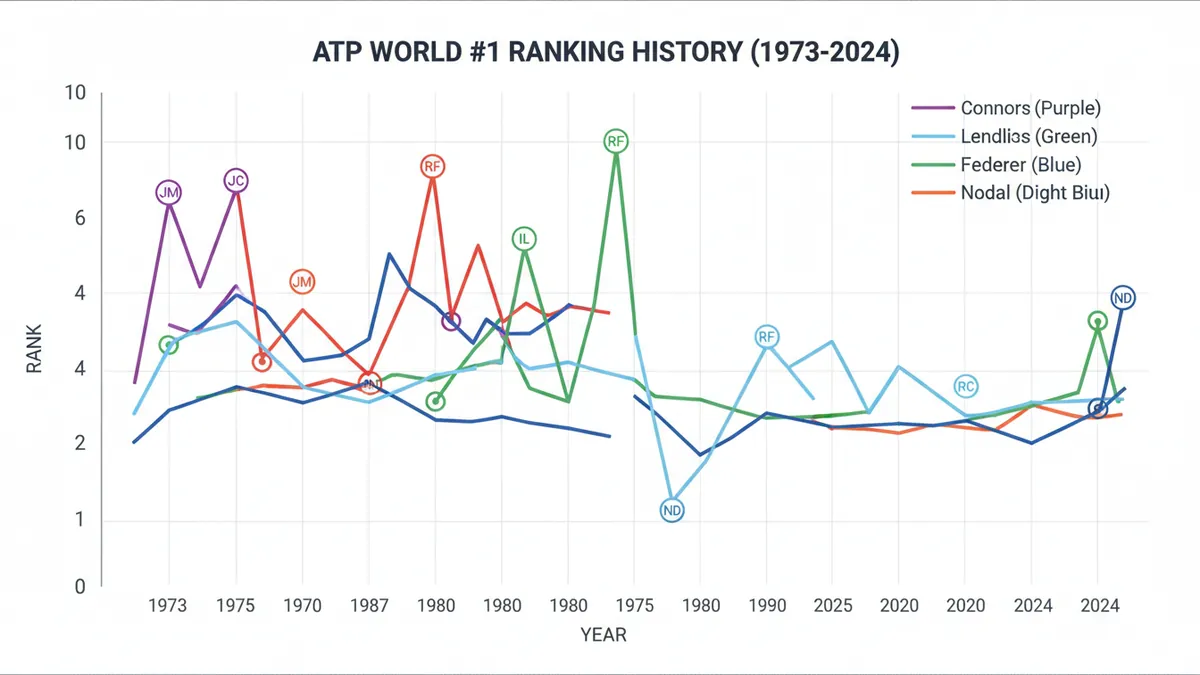
Before 1973, there was no official ranking system — writers, promoters, and national federations produced their own lists with no universal standard. The ATP, founded in 1972, introduced a computer ranking system based on tournament results weighted by prestige.
The system was revolutionary: for the first time, there was an objective measure of who was the best player in the world. It transformed tennis from a collection of individual tournaments into a coherent season-long competition.
The First Era: Connors and Borg (1973–1982)
Ilie Nastase held the inaugural No. 1 ranking in 1973. He was a brilliant, controversial Romanian who combined exceptional skill with outrageous behavior — fined and defaulted more times than any player of his era.
Jimmy Connors dominated the rankings through the mid-1970s, holding No. 1 for an unprecedented 160 consecutive weeks. His aggressive baseline game and ferocious competitive spirit made him one of the sport's defining figures.
Bjorn Borg of Sweden held No. 1 between 1979 and 1981. His five consecutive Wimbledon titles and six French Opens established him as the first undisputed GOAT of the rankings era — cold, precise, and almost machine-like in his consistency.
John McEnroe followed, bringing electric talent alongside legendary temper. His serve-and-volley game and artistic touch made him one of the most gifted players ever.
The 1980s: McEnroe, Lendl and Wilander

Ivan Lendl became the defining player of the 1980s, holding No. 1 for 270 weeks total — a record at the time. His athletic, disciplined approach to the sport modernized professional tennis training. He won 8 Grand Slams despite never winning Wimbledon.
Mats Wilander of Sweden briefly held No. 1 and won 7 Grand Slams across multiple surfaces, showing remarkable versatility.
The 1990s: Sampras's Dominance
Pete Sampras held the year-end No. 1 ranking for a record six consecutive years (1993–1998). His 286 total weeks at the top and 14 Grand Slams made him the dominant figure of his era.
Andre Agassi held No. 1 at various points and achieved the Career Grand Slam — winning all four major titles — which Sampras never accomplished.
Stefan Edberg of Sweden was another defining figure, his serve-and-volley game winning six Grand Slams.
The 2000s: Federer's Reign Begins
Roger Federer reached No. 1 in February 2004 and spent 237 consecutive weeks at the top — the longest unbroken run in history. He ended the 2004, 2005, 2006, 2007, and 2009 seasons as world No. 1 and ultimately spent 310 total weeks at the top (a record later surpassed by Djokovic).
Rafael Nadal and Novak Djokovic entered the picture in the late 2000s, beginning the era of the Big Three.
The Big Three Era (2008–Present)
No period in tennis history rivals the sustained dominance of Federer, Nadal, and Djokovic across two decades.
Novak Djokovic currently holds the record for most weeks at world No. 1: over 400 weeks total. He has been year-end No. 1 eight times and holds 24 Grand Slam titles — the all-time men's record.
Rafael Nadal held No. 1 for 209 total weeks and ended multiple seasons at the top, particularly during his dominant clay court periods.
Weeks at World No. 1 — All-Time Leaders
| Player | Weeks at No. 1 |
|---|---|
| Novak Djokovic | 400+ |
| Roger Federer | 310 |
| Pete Sampras | 286 |
| Ivan Lendl | 270 |
| Jimmy Connors | 268 |
| Rafael Nadal | 209 |
| John McEnroe | 170 |
| Bjorn Borg | 109 |
| Andy Murray | 41 |
| Carlos Alcaraz | Growing |
| Player | Consecutive Weeks |
| Federer | 237 (2004–2008) |
| Sampras | 102 (1993–1996) |
| Connors | 160 |
| Djokovic | 122 (2011–2012) |
The New Era: Sinner and Alcaraz
Carlos Alcaraz became the youngest world No. 1 in ATP history in September 2022, aged 19. Jannik Sinner claimed No. 1 in 2024. The baton has been passed from the Big Three to a new generation, though questions remain about whether either can match the sustained dominance of their predecessors.
Legacy of the Rankings
The ATP ranking system has not been without controversy. It has been criticized for favoring certain surfaces, penalizing injuries, and creating perverse incentives to play through pain. But for 50+ years it has served its core purpose: providing a clear, objective, universally accepted measure of excellence in men's tennis.