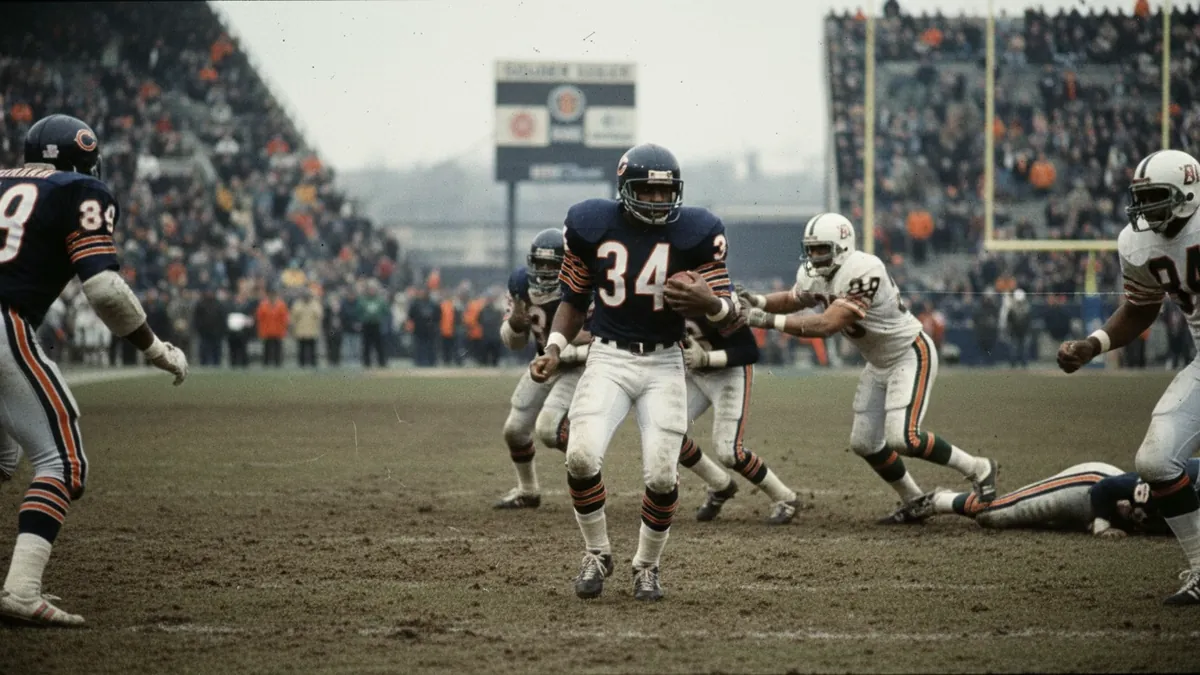
Walter Payton Biography: The Legacy of "Sweetness" and the Greatest Running Back in NFL History
Who Is Walter Payton?

Walter Payton, affectionately known as "Sweetness," was an American professional football player who spent his entire 13-season career as a running back for the Chicago Bears. Born on July 25, 1954, in Columbia, Mississippi, Payton rose to become one of the most prolific and respected figures in the history of the National Football League. At the time of his retirement in 1987, he held nearly every major rushing record, including the all-time marks for career rushing yards and touchdowns. However, Payton was much more than just a statistical marvel; he was a complete football player, renowned for his exceptional blocking, receiving ability, and even his occasional role as a punter and passer. His nickname, "Sweetness," reflected both his smooth running style and his kind, humble personality off the field. Payton's legacy continues to be honored through the NFL's Walter Payton Man of the Year Award, which recognizes a player's excellence on the field and their commitment to philanthropy and community service. He is widely regarded as one of the greatest athletes to ever grace the gridiron, a man whose impact transcended the sport of football.
Early Life and Background
Walter Payton was born into a close-knit family in the racially segregated South of the 1950s. His father, Peter Payton, was a factory worker and a former semi-professional baseball player, while his mother, Alyne, was a homemaker who instilled in her children a strong sense of discipline, faith, and hard work. Growing up in Columbia, Mississippi, Walter was a multi-talented athlete from a young age, excelling in baseball, basketball, and track. Interestingly, he did not play football until his junior year of high school, partly because he didn't want to compete with his older brother, Eddie, who was already a star on the team. Once he did take the field, however, his talent was undeniable. He quickly became one of the top players in the state, leading Columbia's Jefferson High School to numerous victories with his explosive speed and agility. Despite his success, the racial climate of the time limited his college options, leading him to choose Jackson State University, a historically black college in Mississippi, where he would continue to hone his skills and prepare for a career in the professional ranks.
Early Career and College Success

At Jackson State, Walter Payton blossomed into a national superstar and a dominant force in college football. Over his four-year career (1971–1974), he rushed for 3,563 yards and scored a then-NCAA record 65 touchdowns. His performance was so dominant and his style so graceful that he earned the nickname "Sweetness" from his teammates, a moniker that would stay with him for the rest of his life and become synonymous with his legacy. Payton was a two-time All-American and was named the Black College Player of the Year in 1973 and 1974. His ability to dominate the competition at a smaller school caught the attention of NFL scouts, who were impressed by his rare combination of power, speed, and vision. In 1975, the Chicago Bears selected Payton with the fourth overall pick in the NFL Draft, marking the beginning of a legendary partnership that would revitalize one of the league's most historic franchises. Payton's transition to the professional level was seamless, as he quickly established himself as the centerpiece of the Bears' offense and a fan favorite in Chicago.
Professional Career — The Early Years (1975–1981)
Payton's early years in the NFL were characterized by individual brilliance on a team that was often struggling to find its footing and compete with the league's elite. Despite the lack of a strong supporting cast or a consistent passing game, Payton became a workhorse for the Bears, consistently leading the league in carries and rushing yards. In 1977, he had one of the greatest individual seasons in NFL history, rushing for 1,852 yards and scoring 16 touchdowns. His performance that year, which included a then-record 275-yard rushing game against the Minnesota Vikings while suffering from a high fever, earned him the NFL MVP award and established him as the premier running back in the league. Throughout the late 70s and early 80s, Payton was the heart and soul of the Bears, known for his signature "stutter-step" and his refusal to run out of bounds, preferring to initiate contact with defenders and fight for every extra yard. His durability was legendary; he missed only one game in his entire 13-year career, a testament to his incredible physical conditioning, mental toughness, and dedication to his craft.
Professional Career — The Championship Years (1982–1987)
The mid-1980s saw the Chicago Bears evolve into one of the most dominant teams in NFL history, and Walter Payton remained at the center of their success even as the team around him improved. Under head coach Mike Ditka and with the arrival of players like Jim McMahon and the legendary "46 Defense," the Bears became a juggernaut that captured the imagination of the entire country. In 1984, Payton broke Jim Brown's all-time rushing record, a milestone that solidified his status as a living legend and a symbol of the game's history. The pinnacle of his career came in 1985, when the Bears went 15-1 in the regular season and dismantled their opponents in the playoffs to win Super Bowl XX. Although Payton was famously disappointed that he did not score a touchdown in the Super Bowl victory over the Patriots, his presence on the field was vital to the team's success, as he drew constant attention from the defense and opened up opportunities for his teammates. He continued to play at an elite level for two more seasons, eventually retiring after the 1987 season with 16,726 rushing yards, a record that would stand for 15 years until it was broken by Emmitt Smith.
Major Achievements and Records
Walter Payton's list of achievements is among the most impressive in the history of professional sports, reflecting a career of sustained excellence and dominance. He was a 9-time Pro Bowl selection and a 7-time First-Team All-Pro, honors that reflect his standing among his peers and the media. In addition to his 1977 MVP award, he was named the NFL Offensive Player of the Year and was a member of both the NFL 75th Anniversary All-Time Team and the NFL 100th Anniversary All-Time Team. At the time of his retirement, he held records for career rushing yards (16,726), career rushing touchdowns (110), and most games with 100 or more rushing yards (77). He also finished his career with 492 receptions for 4,538 yards, proving his versatility as a dual-threat weapon who could hurt defenses in multiple ways. Payton was inducted into the Pro Football Hall of Fame in 1993, his first year of eligibility, with his son, Jarrett, delivering a moving induction speech that highlighted Walter's character, humility, and dedication to his family as much as his on-field exploits.
Playing Style and Strengths
Walter Payton's playing style was a unique and mesmerizing blend of grace, power, and violence that redefined the running back position. He was known for his incredible balance, which allowed him to stay upright after hits that would have leveled other players, and his signature move was the "stutter-step," a high-stepping maneuver that kept defenders off-balance and allowed him to find holes in the line. Payton was also a devastating blocker, often taking out defenders much larger than himself to protect his quarterback, and his receiving ability made him a constant threat in the passing game. He even threw eight touchdown passes during his career, showcasing an all-around skill set that few players have ever matched. Perhaps his greatest strength, however, was his legendary durability and work ethic. He was famous for his grueling off-season training regimen, which included running up a steep sand hill in his hometown, a practice that gave him the leg strength and endurance to outlast his opponents and remain productive deep into his career. Payton's refusal to go down easily and his willingness to do the "dirty work" made him the ultimate teammate and a nightmare for opposing defenses.
Career Statistics Overview
Walter Payton's career statistics are a testament to his sustained excellence, durability, and versatility over 13 seasons in the NFL. The following table highlights his primary rushing and receiving figures, showcasing his role as the ultimate all-purpose back who could dominate a game in every facet of the offense.
| Category | Statistics |
|---|---|
| Career Rushing Yards | 16,726 |
| Career Rushing Touchdowns | 110 |
| Career Receptions | 492 |
| Career Receiving Yards | 4,538 |
| Career Receiving Touchdowns | 15 |
| Games Played | 190 |
| Seasons with 1,000+ Rushing Yards | 10 |
| Career All-Purpose Yards | 21,264 |
| Career Passing Touchdowns | 8 |
Personal Life
Off the field, Walter Payton was known for his playful personality, his sense of humor, and his deep commitment to his family and community. He married his college sweetheart, Connie Norwood, in 1976, and they had two children, Jarrett and Brittney, both of whom have continued to honor their father's legacy. Payton was an avid and successful businessman, owning various ventures including a restaurant, a racing team, and real estate holdings. He was also deeply involved in charitable work, establishing the Walter Payton Foundation to support underprivileged children and veterans, a cause that was close to his heart. Despite his massive fame and success, Payton remained remarkably humble and was known for his accessibility to fans, often spending hours signing autographs and talking to people. In early 1999, Payton shocked the world by announcing that he was suffering from a rare liver disease, primary sclerosing cholangitis. He spent his final months advocating for organ donation, using his platform to raise awareness for a cause that could save countless lives. Walter Payton passed away on November 1, 1999, at the age of 45, leaving behind a legacy of kindness, strength, and integrity that touched millions of people around the world.
Legacy and Impact
The impact of Walter Payton on the NFL, the city of Chicago, and the world of sports cannot be overstated. He remains the most beloved and iconic figure in the history of the Chicago Bears, a player who embodied the city's blue-collar work ethic and resilient spirit during both the good times and the bad. The NFL honored his legacy by renaming its most prestigious off-field award the Walter Payton NFL Man of the Year Award, which is given annually to a player who excels on the field and makes a significant positive impact in their community through charitable work. His rushing records were eventually broken by Emmitt Smith, but many experts and fans still consider Payton the greatest all-around running back to ever play the game due to his complete skill set. His influence is seen in the way modern running backs are evaluated, with an emphasis on their ability to block and catch as well as run. Beyond football, Payton's advocacy for organ donation led to a significant and lasting increase in donor registrations, a final act of service that continues to save lives today. He is remembered not just as a champion and a record-breaker, but as a man of immense character who lived his life with "Sweetness" and left the world a better place than he found it.
Conclusion
Walter Payton's life and career were a masterclass in excellence, durability, and humanity, providing a blueprint for what it means to be a professional athlete and a leader. From the segregated fields of Mississippi to the bright lights of the Super Bowl and the halls of the Pro Football Hall of Fame, he proved that greatness is achieved through hard work, perseverance, and an unwavering spirit. He redefined the running back position and set a standard for professional athletes that remains the benchmark for greatness today. While his records may be surpassed by future generations, the impact he had on the game and the people he touched will never be forgotten. Walter Payton was more than just a football player; he was a symbol of hope, a man of character, and a reminder that true greatness is measured by what you give back to others. As long as football is played, the name Walter Payton will be spoken with reverence and admiration, a fitting tribute to a man who truly was "Sweetness" in every sense of the word and whose legacy will continue to inspire for years to come.
Frequently Asked Questions (FAQ)
1. Why was Walter Payton called "Sweetness"?
The nickname originated during his college days at Jackson State, referring to both his smooth, graceful running style on the field and his kind, gentle personality off the field.
2. Did Walter Payton ever win a Super Bowl?
Yes, Walter Payton was a key member of the 1985 Chicago Bears team that won Super Bowl XX, defeating the New England Patriots 46-10 in one of the most dominant performances in NFL history.
3. What records does Walter Payton still hold?
While his career rushing records have been broken, Payton still holds numerous Chicago Bears franchise records and remains high on the all-time NFL lists for yards, touchdowns, and all-purpose yards.
4. What is the Walter Payton Man of the Year Award?
It is an annual award given by the NFL to a player who demonstrates excellence on the field and makes a significant positive impact in their community through charitable work and philanthropy.
5. How did Walter Payton die?
Walter Payton passed away in 1999 at the age of 45 due to complications from primary sclerosing cholangitis, a rare liver disease, and bile duct cancer, which he faced with the same courage he showed on the football field.