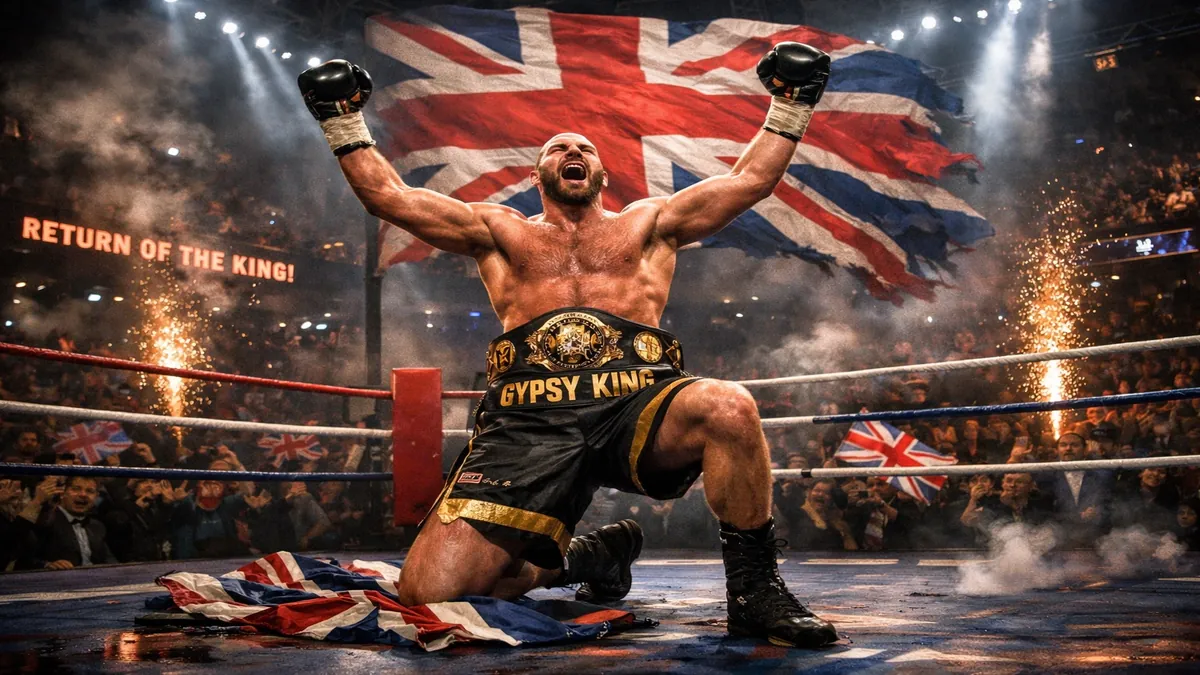
Tyson Fury Biography: The Gypsy King's Comeback Story
Tyson Fury is one of the most extraordinary figures in boxing history — not primarily because of his achievements in the ring, though they are considerable, but because of what he overcame to achieve them. His comeback from depression, cocaine addiction, and morbid obesity to become world heavyweight champion is one of sport's greatest personal triumph stories.
Early Life and Traveller Heritage

Tyson Luke Fury was born on August 12, 1988, in Wythenshawe, Manchester, England, three months premature and given little chance of survival. His father, John Fury — himself a professional boxer — named him Tyson after Mike Tyson. The family is part of the Irish Traveller community, a nomadic ethnic group with deep roots in Ireland and Britain.
Fury grew up in a family where boxing was the primary language. His father, uncles, and cousins all boxed. He was trained from a young age and showed exceptional talent — standing 6'9" (206 cm) with a wingspan of over 85 inches, he had physical attributes that no heavyweight in history had possessed alongside genuine boxing skill.
Amateur and Early Professional Career
Fury had a successful amateur career before turning professional in 2008. His height and reach were immediately problematic for opponents — he combined unusual boxing skill with the kind of physical dimensions that make distance management nearly impossible.
He won his early fights impressively, building a record that attracted attention in British boxing. By 2011 he was fighting for the British and Commonwealth titles and beyond.
Defeating Wladimir Klitschko (2015)

On November 28, 2015, Fury challenged Wladimir Klitschko for the unified WBA, IBF, WBO, and IBO heavyweight titles in Dusseldorf, Germany. Klitschko had dominated the heavyweight division for nine years, making 23 successful title defenses with a calculated, jab-and-grab style.
Fury disrupted Klitschko's system completely. He was constantly moving, throwing from unexpected angles, making faces, taunting, switching stances. The crowd, expecting a comfortable Klitschko victory, was baffled. Fury won by unanimous decision — his performance as a technical boxing masterclass was one of the best heavyweight championship performances of the century.
The Darkness: Depression and Addiction
Following his victory, Fury fell into severe depression. He gained enormous amounts of weight (reportedly reaching 400+ pounds), began using cocaine and alcohol heavily, and spoke openly about suicidal thoughts in interviews. In 2016 he made public statements that suggested genuine crisis.
His boxing license was suspended due to the failed drug test (cocaine). He ballooned in weight. His WBA title was stripped. Most observers assumed his boxing career was over.
What made Fury's depression particularly significant in sporting terms was his willingness to discuss it openly — in a sport characterized by performative toughness, his honesty about mental health struggles was genuinely unusual and helped reduce stigma around these discussions.
The Comeback
Fury returned to boxing in 2018 after a two-and-a-half year absence, fighting lower-ranked opponents to rebuild fitness and ring sharpness. His weight had come down, his sobriety was (mostly) established, and his belief that he could reach the top again was unshakeable.
The Wilder Trilogy
Wilder I (December 2018): Fury challenged WBC champion Deontay Wilder in Los Angeles. Wilder — the most feared puncher in boxing, undefeated, with devastating one-punch knockout power — knocked Fury down in the 12th round with a combination that left him flat on his back, apparently unconscious.
What followed was extraordinary: Fury rose from the canvas, rolled his shoulders, and finished the round. The fight was scored a split draw — controversial, as most observers felt Fury had won overall before the knockdown. The image of Fury rising from what appeared a knockout became one of boxing's most iconic moments.
Wilder II (February 2020): Fury dominated Wilder from the opening round, knocking him down twice and stopping him in the seventh round. The performance was a tactical masterclass — Fury had studied Wilder's vulnerabilities and attacked them systematically.
Wilder III (October 2021): A brutal, violent fight with multiple knockdowns. Fury was knocked down twice but rose each time, eventually knocking Wilder out in the 11th round. Fury's chin — his ability to absorb Wilder's legendary power and recover — proved ultimately decisive.
Legacy and Character
Fury is one of boxing's most colorful, controversial, and genuinely fascinating figures. His post-fight celebrations — singing in the ring, dancing, impersonating various characters — reflect a personality that is simultaneously larger-than-life performer and deeply vulnerable human being.
His openness about mental health, his Traveller cultural identity, his relationship with his father (whose ear-biting incident led to a prison sentence), and his genuine religious conviction all contribute to a portrait of extraordinary complexity.
As a boxer, the 6'9" heavyweight who moves like a middleweight, has exceptional reflexes, and can absorb punishment that stops other men is genuinely unique. His record of victories over Klitschko, Wilder (twice), and other top heavyweights establishes him among the great champions of the modern era.