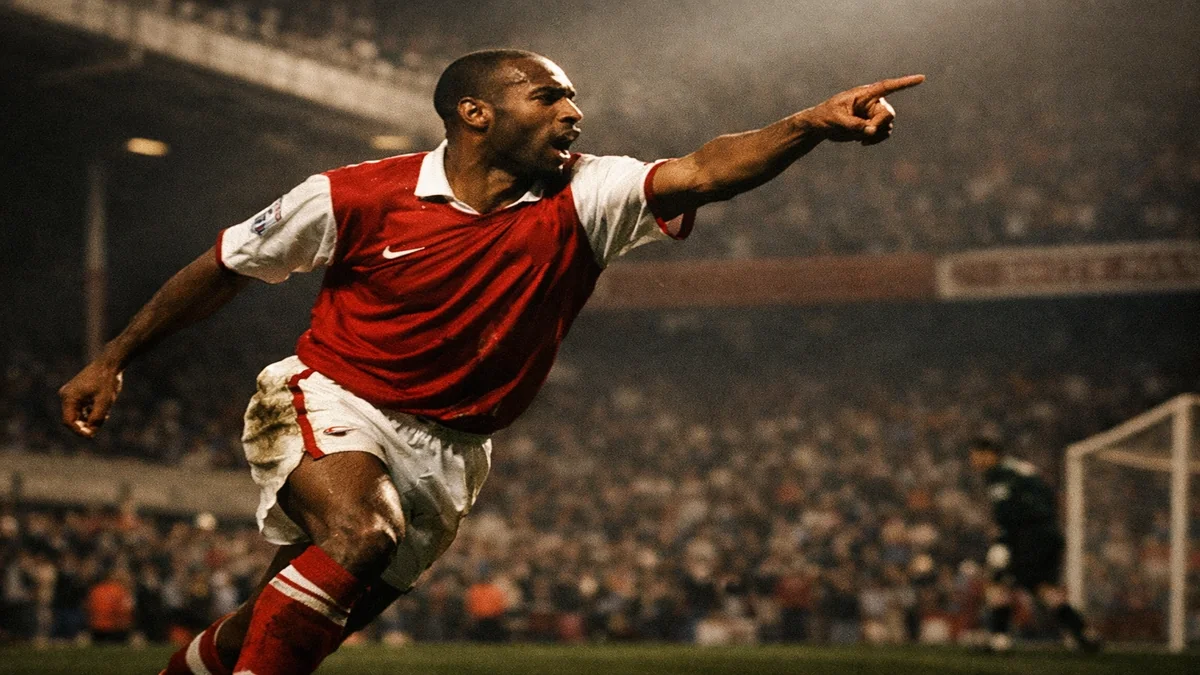
Thierry Henry Biography
Thierry Daniel Henry, born on August 17, 1977, in Les Ulis, a suburb of Paris, France, is widely regarded as one of the greatest strikers of all time. His journey from the tough streets of his hometown to becoming a global football icon, breaking goal-scoring records and winning numerous trophies with clubs like Arsenal and Barcelona, is a testament to his exceptional talent, unwavering dedication, and revolutionary playing style. Renowned for his blistering pace, exquisite dribbling, and clinical finishing, Henry redefined the role of a modern forward, seamlessly blending goal-scoring prowess with creative flair. This Thierry Henry biography explores the life and career of a player who consistently performed at the highest level, showcasing how his unique blend of technical mastery and footballing intelligence allowed him to thrive at the pinnacle of European football and become a true legend of the sport.
Early Life and Formative Years in Les Ulis

Thierry Henry's early life was rooted in Les Ulis, a commune in the southern suburbs of Paris, France. Born to parents Antoine and Marylese Henry, his upbringing was characterized by a strong emphasis on discipline and hard work. From a very young age, Henry displayed an extraordinary passion and natural aptitude for football. He spent countless hours playing in the streets and local pitches, honing his skills and developing the raw talent that would later make him a global superstar. His father, Antoine, played a crucial role in nurturing his talent, often pushing him to train harder and focus on his technique. Henry's organized football journey began at local clubs, where his exceptional speed and goal-scoring ability quickly caught the eye. He joined CO Les Ulis at the age of seven, the same club where future French international Patrice Evra would also begin his career. Even in these early years, Henry's coaches recognized his immense potential, noting his natural athleticism and his keen eye for goal. He later moved to US Palaiseau and then Viry-Châtillon, continuing his development in the highly competitive Parisian youth football scene. A pivotal moment in his youth career came when he was accepted into the prestigious Clairefontaine national football academy, a renowned institution known for producing some of France's finest talents. This experience provided him with top-tier coaching and a structured environment to further refine his skills. His time at Clairefontaine, followed by a move to AS Monaco's youth system, laid the crucial groundwork for his professional career, instilling in him the technical foundation, tactical understanding, and mental fortitude that would later propel him to global stardom. This formative period was instrumental in shaping the player and person he would become, preparing him for the demands of elite professional football.
AS Monaco, Juventus, and the Arsenal Revolution
Thierry Henry's professional career began at AS Monaco, where he made his debut in 1994 under the guidance of Arsène Wenger. It was at Monaco that Henry, initially playing as a left winger, began to showcase his blistering pace and dribbling skills. He played a crucial role in Monaco's Ligue 1 title win in the 1996-97 season and impressed in the UEFA Champions League, drawing attention from top European clubs. His performances earned him a move to Italian giants Juventus in January 1999. However, his time in Serie A was short-lived and largely unsuccessful, as he struggled to adapt to the tactical demands of Italian football and was often played out of position. This setback, rather than deterring him, proved to be a crucial learning experience. The turning point in Henry's career came in August 1999 when he reunited with his former mentor, Arsène Wenger, at Arsenal. Wenger, recognizing Henry's immense potential, famously converted him from a winger into a central striker. This tactical masterstroke unleashed Henry's full capabilities, transforming him into one of the most feared forwards in the world. At Arsenal, Henry blossomed into a global superstar. He became the focal point of Arsenal's attack, leading the club to unprecedented success. He was the spearhead of Arsenal's "Invincibles" team, which went an entire Premier League season unbeaten in 2003-04. He won two Premier League titles and two FA Cups with the Gunners, and became the club's all-time leading goalscorer with 228 goals across all competitions. His individual accolades during this period were numerous, including four Premier League Golden Boots, two PFA Players' Player of the Year awards, and three FWA Footballer of the Year awards. He was also twice runner-up for both the FIFA World Player of the Year and the Ballon d'Or. Henry's time at Arsenal was characterized by a blend of breathtaking individual brilliance and selfless team play. He was not just a goalscorer; he was a creator, a leader, and an inspiration. His iconic celebrations, his ability to score spectacular goals, and his unwavering commitment to the club endeared him to the Arsenal faithful, who affectionately dubbed him "King Henry." His departure from Arsenal in 2007, after eight glorious years, marked the end of an era, but his legacy as the greatest player in the club's history was firmly cemented. This period was the peak of his Thierry Henry career, where he consistently delivered at the highest level, transforming Arsenal into one of Europe's most exciting teams.
Barcelona, MLS, and International Glory

After his legendary spell at Arsenal, Thierry Henry embarked on new challenges, first with FC Barcelona and then with the New York Red Bulls in Major League Soccer (MLS), while also continuing to achieve international glory with France. His move to Barcelona in 2007 saw him adapt his game to fit into Pep Guardiola's revolutionary 'tiki-taka' system. While his goal tally might not have reached the heights of his Arsenal days, Henry played a crucial role in Barcelona's historic treble-winning season in 2008-09, where they won La Liga, the Copa del Rey, and the UEFA Champions League. He formed a formidable attacking trio with Lionel Messi and Samuel Eto'o, showcasing his versatility and tactical intelligence by often playing on the left wing. With Barcelona, he added two La Liga titles, a Copa del Rey, a UEFA Super Cup, and a FIFA Club World Cup to his impressive trophy cabinet. In 2010, Henry moved to the New York Red Bulls in MLS, where he continued to demonstrate his class and experience. He became a prominent figure in the league, helping to raise its profile and inspiring a new generation of American footballers. His time in MLS was marked by spectacular goals and leadership, proving that he still possessed the magic that made him a global superstar. Internationally, Henry was a cornerstone of the French national team for over a decade. He was a key member of the squad that won the 1998 FIFA World Cup on home soil, and followed that up with victory in the UEFA European Championship in 2000. He became France's all-time leading goalscorer, a record he held for many years, and represented his country in four World Cups and three European Championships. His international career was filled with memorable moments, showcasing his ability to perform on the biggest stages. This period of his career demonstrated Henry's adaptability, his enduring quality, and his commitment to the sport across different leagues and continents, further solidifying his status as a true footballing legend.
Achievements, Records, and Trophies: A Storied Career
Thierry Henry's career is adorned with an astonishing array of individual accolades and team trophies, reflecting his status as one of the most decorated footballers of his generation. His consistent excellence and prolific goal-scoring have earned him a place among the sport's all-time greats.
Major Team Honors:
- Ligue 1 (AS Monaco): 1996–97
- Trophée des Champions (AS Monaco): 1997
- Premier League (Arsenal): 2001–02, 2003–04 (The Invincibles)
- FA Cup (Arsenal): 2002, 2003, 2005
- FA Community Shield (Arsenal): 2002, 2004
- La Liga (FC Barcelona): 2008–09, 2009–10
- Copa del Rey (FC Barcelona): 2008–09
- Supercopa de España (FC Barcelona): 2009
- UEFA Champions League (FC Barcelona): 2008–09
- UEFA Super Cup (FC Barcelona): 2009
- FIFA Club World Cup (FC Barcelona): 2009
- FIFA World Cup (France): 1998
- UEFA European Championship (France): 2000
- FIFA Confederations Cup (France): 2003
- Premier League Golden Boot: 2001–02, 2003–04, 2004–05, 2005–06
- European Golden Shoe: 2003–04, 2004–05
- PFA Players' Player of the Year: 2002–03, 2003–04
- FWA Footballer of the Year: 2002–03, 2003–04, 2005–06
- FIFA World Player of the Year: Runner-up 2003, 2004
- Ballon d'Or: Runner-up 2003, Third place 2006
- Arsenal All-Time Leading Goalscorer: 228 goals
- France National Team All-Time Leading Goalscorer: 51 goals (held until 2022)
- Most goals scored at Highbury (Arsenal's former stadium): 116 goals
- Only player to score 20+ goals in 5 consecutive Premier League seasons
Key Individual Awards & Records:
These achievements highlight Henry's incredible consistency and his ability to perform at the highest level for over a decade. His numerous Golden Boot awards, both in England and across Europe, underscore his status as a truly elite goalscorer. His World Cup and European Championship triumphs with France, coupled with his Champions League victory with Barcelona, solidify his place among the pantheon of footballing legends. The recognition as runner-up for both the FIFA World Player of the Year and the Ballon d'Or on multiple occasions further emphasizes his individual brilliance during his peak years. Henry's record-breaking goal tallies for both Arsenal and the French national team firmly establish him as an icon in both club and international football.
Playing Style & Strengths: The Art of the Striker
Thierry Henry's playing style was a captivating blend of raw athleticism, exquisite technical skill, and an unparalleled footballing intelligence, making him one of the most aesthetically pleasing and effective strikers of his era. Primarily operating as a left-sided forward or a central striker, Henry possessed a unique ability to influence the game from various positions, often drifting wide to exploit space before cutting inside to unleash his potent right foot. His most prominent strength was his blistering pace and acceleration, which he used devastatingly to burst past defenders and create goal-scoring opportunities. This speed is complemented by exceptional dribbling skills, allowing him to glide past opponents with effortless grace and close control. Henry's finishing was clinical and varied; he was capable of scoring spectacular long-range efforts, delicate chips over advancing goalkeepers, and powerful shots from inside the box. His composure in front of goal, especially in high-pressure situations, was a hallmark of his game. Beyond his prolific scoring, Henry's intelligence and tactical awareness were significant strengths. He excelled at making intelligent runs off the ball, exploiting gaps in the opposition defense, and creating space for his teammates. His ability to link up play, often dropping deep to receive the ball and initiate attacks, showcased his versatility and understanding of the game. He was also an excellent passer, capable of delivering precise through balls and crosses. Comparing him to legendary players, Henry shared the elegance and goal-scoring prowess of a Marco van Basten, combined with the explosive speed and dribbling ability of a young George Weah. His ability to consistently perform at an elite level, coupled with his adaptability and continuous improvement, made him a truly unique and formidable opponent for any defense, solidifying his reputation as one of the most well-rounded and complete strikers in the history of the game. His leadership qualities and mental fortitude further enhanced his value, making him a complete package for any top team.
Legacy and Post-Playing Career: A Continuing Influence
Thierry Henry's legacy in football is firmly established as a global icon and one of the greatest players of all time. His relentless pursuit of excellence, record-breaking goal tallies, and consistent performance at the highest level for over a decade have cemented his place in the pantheon of footballing legends. Beyond the statistics, Henry is admired for his professionalism, his articulate insights into the game, and his passion for football. He has been a symbol of elegance and effectiveness, inspiring countless aspiring footballers with his unique style and dedication. His impact extends beyond the pitch, as he has transitioned into a successful career as a pundit, sports broadcaster, and coach. After retiring from playing, Henry embarked on a coaching career, working with Arsenal's youth teams, serving as an assistant coach for the Belgium national team, and managing AS Monaco and Montreal Impact. His coaching journey reflects his desire to impart his vast knowledge and experience to the next generation of players. As a pundit, he is highly respected for his insightful analysis and deep understanding of the game, often appearing on major sports networks. His contributions to the game, both as a player and in his post-playing career, continue to shape the footballing landscape. Henry's influence remains profound, and his status as a modern football icon whose achievements and artistry will be remembered for generations is undeniable. He continues to be a prominent figure in the football world, demonstrating his enduring passion and commitment to the sport that he graced with such distinction.
FAQ: Thierry Henry Biography
Q: When and where was Thierry Henry born?
A: Thierry Henry was born on August 17, 1977, in Les Ulis, a suburb of Paris, France.
Q: Which club is Thierry Henry the all-time leading goalscorer for?
A: Thierry Henry is the all-time leading goalscorer for Arsenal, with 228 goals.
Q: What are Thierry Henry's main playing strengths?
A: Thierry Henry's main playing strengths included his blistering pace, exceptional dribbling ability, clinical finishing, intelligent movement off the ball, and versatility as a forward or winger.