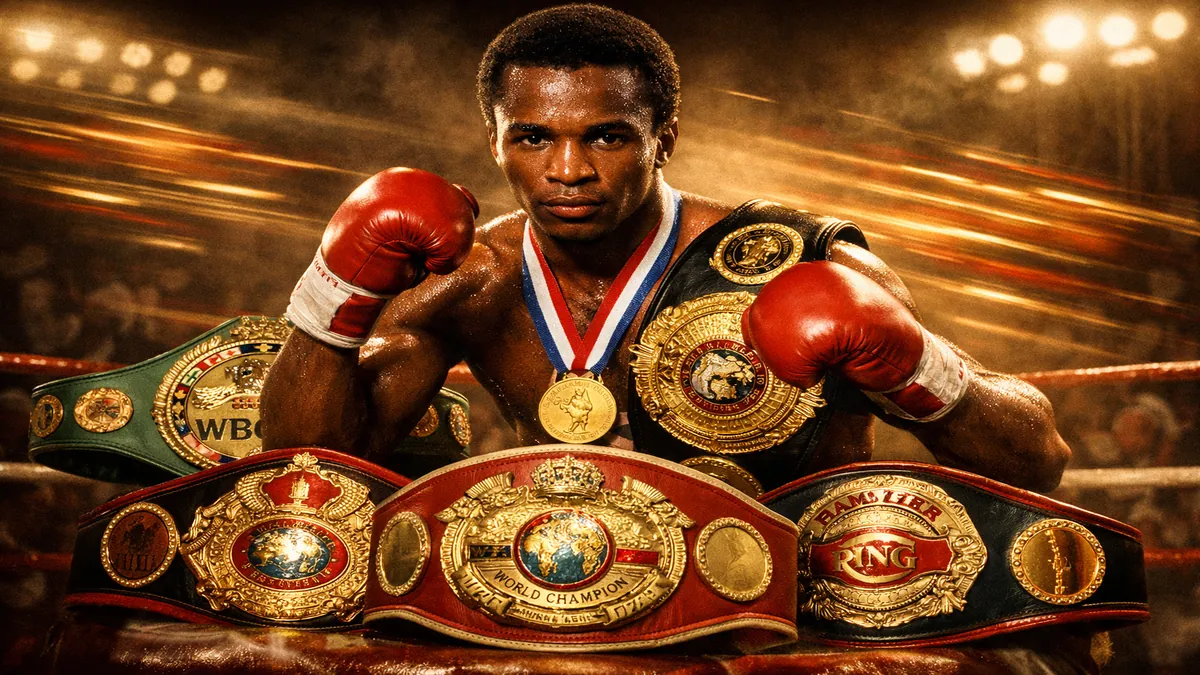
Sugar Ray Leonard Biography: Five-Division Champion and the Greatest of the 1980s
Sugar Ray Leonard is among the most complete boxers in history — an Olympic gold medalist who became a five-division world champion through a combination of exceptional speed, power, tactical intelligence, and the ability to produce his best performances in the biggest fights. His rivalry with the "Four Kings" — Duran, Hearns, and Hagler — defined boxing's most celebrated decade.
Early Life

Ray Charles Leonard was born on May 17, 1956, in Wilmington, North Carolina, and grew up in Palmer Park, Maryland. He came from a modest background and discovered boxing at 14. His natural speed and reflexes were obvious immediately — coaches compared his hand speed to the greatest lightweights they had seen.
His nickname "Sugar Ray" came from his boxing idol Sugar Ray Robinson — the greatest pound-for-pound fighter in history — and the comparison would prove apt across his career.
1976 Olympic Gold
Leonard was the star of the 1976 Montreal Olympics, winning the light welterweight gold medal with performances that captivated television audiences. He won the Val Barker Trophy (given to the tournament's most outstanding boxer) and returned home a national celebrity.
He announced his retirement at the Olympics and enrolled at the University of Maryland to study. But family financial pressures brought him back to boxing.
Professional Career: Rapid Rise

Leonard turned professional in February 1977 and progressed rapidly. By 1979, he was WBC welterweight champion after defeating Wilfred Benitez (stopped in the 15th round with six seconds remaining). His promoter, Mike Trainer, negotiated deals that made Leonard the highest-paid fighter of his era.
The Four Great Rivalries
vs. Roberto Duran I (June 1980): "Hands of Stone" Duran came up from lightweight and fought the most physical, dirty, clinching fight imaginable. Leonard tried to box; Duran roughhoused and won the decision in one of the most surprising upsets of the era.
vs. Roberto Duran II (November 1980) — "No Más": In the rematch, Leonard danced, taunted, and frustrated Duran relentlessly. In the eighth round, Duran turned away from a Leonard combination and said the most famous two words in boxing: "No más." No more. He quit in the ring.
vs. Thomas Hearns I (September 1981) — "The Showdown": Hearns was leading on points through 12 rounds and looked on course for victory. Leonard, eye swelling shut from Hearns's jab, abandoned his boxing and attacked. He knocked Hearns down twice and stopped him in the 14th round in a dramatic finish that is among the greatest comeback knockouts.
vs. Marvin Hagler (April 1987): After a three-year retirement for eye surgery, Leonard came back to challenge the undisputed middleweight champion — moving up two weight classes, having fought just once in five years. Leonard's movement, hand speed, and showboating over 12 rounds produced a split decision victory. Hagler contested the result until his death, and the fight remains among the most debated decisions in boxing history.
Five Division Titles
Leonard won world titles at:
- Welterweight (WBC, 1979)
- Junior Middleweight (WBA, 1981)
- Middleweight (WBC, 1987)
- Super Middleweight (WBC, 1988)
- Light Heavyweight (WBC, 1988)
The five-division achievement was unprecedented at the time — he remains one of boxing's great multi-division champions.
Legacy
Sugar Ray Leonard finished 36-3-1, with 25 knockouts. More than the record, his place in boxing history rests on the quality of his opponents — Duran, Hearns, and Hagler were all all-time greats — and his ability to produce career-defining performances in their biggest fights.
The 1981 fight against Hearns, in particular, represents boxing at its dramatic peak: a fighter appearing beaten, then finding something — courage, desperation, or pure will — to turn the fight completely.