Steffi Graf Biography: Tennis's Most Complete Champion
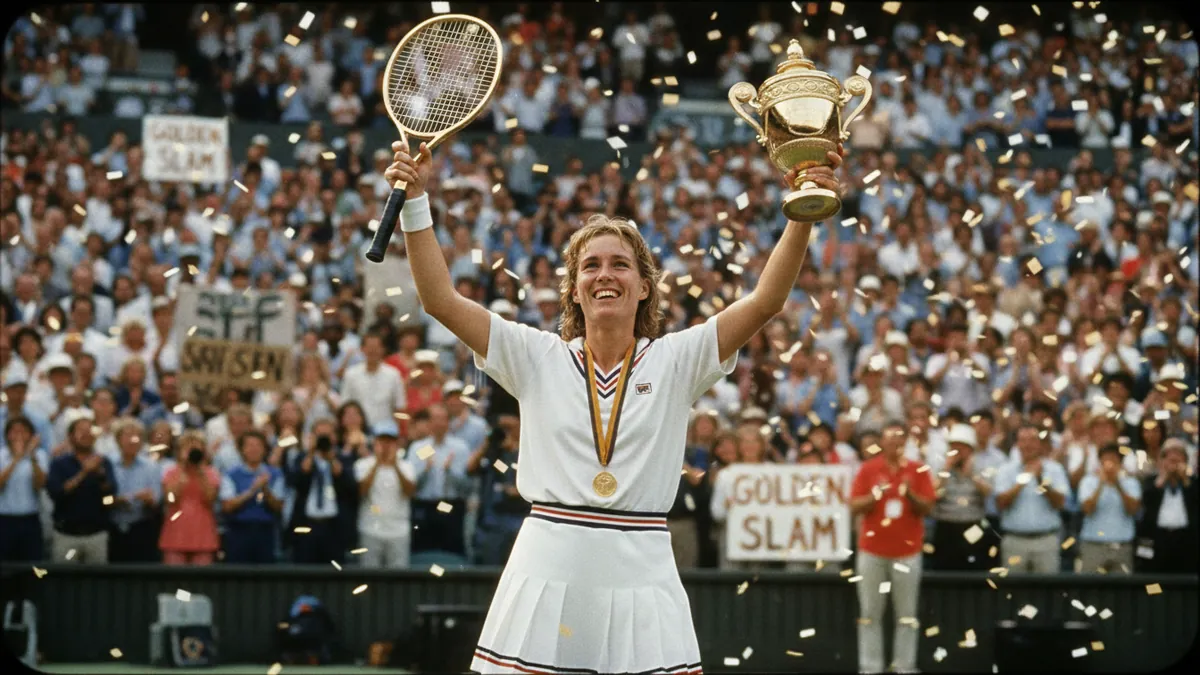
Steffi Graf is the most statistically dominant player in women's tennis history. With 22 Grand Slam singles titles, 377 weeks at world No. 1, and the only Golden Slam in tennis history — winning all four Grand Slams AND Olympic gold in the same year — Graf set benchmarks that remain untouched decades after her retirement.
Early Life and Germany

Stefanie Maria Graf was born on June 14, 1969, in Mannheim, West Germany (now Germany). Her father, Peter Graf, recognized her talent early and became her primary coach, training her obsessively from age four. Peter Graf's methods were controversial — he was later convicted of tax evasion related to his daughter's earnings — but his impact on her development was undeniable.
Graf was a child prodigy in every sense. She was playing competitively at six, won a national championship at eight, and turned professional at 13. The tennis world quickly recognized that it was dealing with an extraordinary talent.
The Forehand That Changed Women's Tennis
Graf's forehand is widely considered the greatest single shot in women's tennis history. It was hit flat, with tremendous pace, disguise, and precision. In an era when women's tennis favored consistency over power, Graf's forehand was simply on another level.
Her movement was exceptional — quick, economical, and perfectly balanced. Her serve was a genuine weapon, not just a means to start a rally. Her backhand, a sliced one-hander, was criticized early in her career but evolved into an effective tactical shot.
She played aggressive, attacking tennis from the baseline — an approach that influenced a generation of players who followed.
The Golden Slam: 1988

1988 was the greatest single season in women's tennis history. Graf won all four Grand Slams — Australian Open, Roland Garros, Wimbledon, and US Open — plus the Olympic gold medal at the Seoul Games. No player, male or female, has achieved this before or since.
The year included one of the most celebrated Wimbledon finals ever: Graf defeated Martina Navratilova in three sets in a match of the highest quality. She finished the year having won all four slams and the Olympics, with her only significant loss coming against Gabriela Sabatini in the Becker Cup.
The achievement earned a new term in tennis vocabulary: the Golden Slam.
Grand Slam Titles: The Numbers
Total: 22 Grand Slam singles titles
- Roland Garros: 6 (1987, 1988, 1993, 1994, 1995, 1996)
- Wimbledon: 7 (1988, 1989, 1991, 1992, 1993, 1995, 1996)
- US Open: 5 (1988, 1989, 1993, 1994, 1995)
- Australian Open: 4 (1988, 1989, 1990, 1994)
Her 22 Grand Slam titles is the second highest in women's tennis history behind Serena Williams's 23. She won on all four surfaces, proving she was the most complete champion the women's game had produced.
Rivalries
Steffi Graf vs. Martina Navratilova defined the transition of eras in women's tennis. Navratilova was the dominant force until Graf arrived, and their battles — particularly at Wimbledon — were among the sport's great contests.
Steffi Graf vs. Monica Seles was a rivalry cut short by tragedy. Seles was the only player who genuinely challenged Graf's dominance in the early 1990s, winning seven Grand Slams between 1991 and 1993. In April 1993, Seles was stabbed on court during a match in Hamburg by a disturbed German fan of Graf's. Seles was sidelined for over two years. The incident cast a shadow over Graf's subsequent titles during that period.
World No. 1: 377 Weeks
Graf held the world No. 1 ranking for 377 weeks across her career — a record in women's tennis surpassed only by Serena Williams. She was year-end No. 1 eight times, from 1987 to 1996 with only brief interruptions from Seles.
Retirement
Graf retired in August 1999, aged 30, citing knee problems. She went out at the top — her final Wimbledon, in 1999, saw her reach the final. Her retirement announcement shocked the tennis world, as she remained world No. 3 and still a contender for major titles.
Life After Tennis
Graf married fellow tennis legend Andre Agassi in 2001, in a relationship that began as a friendship during their playing days. They live in Las Vegas and have two children. Both remain involved in philanthropy, particularly through the Andre Agassi Foundation for Education and Graf's own Children for Tomorrow foundation.
She is famously private, rarely granting interviews and avoiding the celebrity circuit that attracts many former champions.
Legacy
The debate over the greatest women's tennis player is ultimately one between Steffi Graf and Serena Williams. Williams has 23 Grand Slam titles to Graf's 22, but Graf's domination of an era — her win percentage, weeks at No. 1, the Golden Slam — makes comparisons genuinely difficult.
What is beyond debate: Steffi Graf changed what was possible in women's tennis, set records that stood for decades, and played the game with a purity of excellence that remains the benchmark for all who followed.