Pittsburgh Steelers History: 6 Super Bowl Championships and the Greatest Dynasty in NFL History
Franchise Overview

The Pittsburgh Steelers are one of the most storied and successful franchises in the history of the National Football League. Founded in 1933, the team is the oldest franchise in the AFC. Based in Pittsburgh, Pennsylvania, the Steelers compete in the AFC North division and play their home games at Acrisure Stadium. Known for their iconic black and gold colors—the only NFL team to share colors with all other major professional sports teams in its city—the Steelers are defined by a culture of stability, physical toughness, and defensive excellence. With six Super Bowl titles, they are tied for the most in NFL history, and their "Steel Curtain" defense of the 1970s remains the gold standard for defensive dominance. The Steelers are more than just a football team; they are a symbol of the city's industrial heritage and a beacon of consistency in an ever-changing league. Their success is rooted in a philosophy that emphasizes character, discipline, and a commitment to winning the "right way," a strategy that has made them one of the most respected organizations in all of professional sports.
Founding and Early Years (1933–1968)
The team was founded by Arthur J. Rooney on July 8, 1933, originally named the Pittsburgh Pirates. The early decades were marked by struggle; for the first 40 years of their existence, the Steelers were perennial bottom-dwellers in the NFL. They made only one playoff appearance during this time (a 1947 loss to the Eagles). Despite the lack of on-field success, Art Rooney’s commitment to the city and the sport earned him the nickname "The Chief" and established the family-oriented culture that still defines the organization. The team faced financial difficulties and even temporary mergers during World War II, such as the "Steagles" merger with the Philadelphia Eagles in 1943. However, Rooney's resolve never wavered, and he remained a beloved figure in the Pittsburgh community. The turning point came in 1969 with the hiring of a young defensive coach named Chuck Noll, which signaled the end of the "Same Old Steelers" era and the beginning of a transformation that would change the NFL forever. Noll's arrival brought a new level of professionalism and a focus on building through the draft, a strategy that would soon bear fruit in the most spectacular way possible.
The Steel Curtain Era — 1970s

The 1970s was the decade that transformed the Steelers from losers into legends. Under Chuck Noll, the team built through the draft, selecting four future Hall of Famers in the 1974 NFL Draft alone (Lynn Swann, Jack Lambert, John Stallworth, and Mike Webster). Led by the "Steel Curtain" defensive line—featuring Mean Joe Greene, L.C. Greenwood, Ernie Holmes, and Dwight White—the Steelers became the only team to win four Super Bowls in a six-year span (IX, X, XIII, XIV). Quarterback Terry Bradshaw and running back Franco Harris provided the offensive firepower, but it was the defense that struck fear into the hearts of opponents. This era was characterized by a physical, punishing style of play that became the team's identity. The Steelers of the 70s weren't just winning games; they were dominating an entire era of professional football, creating a legacy that still defines the franchise today. Their victory in Super Bowl IX was the culmination of years of rebuilding, and it established the Steelers as a national powerhouse, a status they have rarely relinquished in the decades since.
The Cowher and Tomlin Eras — 1992–2025
Following Noll's retirement, the Steelers maintained their winning tradition under just two head coaches over the next 34 years: Bill Cowher (1992–2006) and Mike Tomlin (2007–2025). Bill Cowher, known for his fiery personality and "The Jaw," led the team to a victory in Super Bowl XL, ending a 26-year championship drought and solidifying his place in Steelers lore. Mike Tomlin took over in 2007 and immediately led the team to a win in Super Bowl XLIII, becoming the youngest head coach to win a Super Bowl at the time. Tomlin’s tenure was marked by incredible consistency; he famously never had a losing record in his 19 seasons as head coach, a record that is a testament to his leadership and the organization's stability. This era was led by the "Killer B's" (Ben Roethlisberger, Antonio Brown, and Le'Veon Bell) and later a dominant defense led by T.J. Watt and Cam Heyward. The stability at the head coaching position—having only three coaches since 1969—is a feat unmatched in modern professional sports and is a primary reason for the team's sustained success and its ability to remain competitive year after year.
Greatest Players in Franchise History
The Steelers' Hall of Fame roster is a "who's who" of NFL history. Joe Greene is widely considered the greatest Steeler of all time, the cornerstone of the 1970s dynasty and the player who changed the team's culture from one of losing to one of expectation. Terry Bradshaw won four Super Bowls and an MVP, proving his worth as a big-game performer whose arm talent was often underrated. Franco Harris provided the most iconic moment in NFL history with the "Immaculate Reception," a play that sparked the team's rise to greatness. In the modern era, Ben Roethlisberger finished his career in the top 10 of almost every major passing category, leading the team to three Super Bowl appearances and two wins. T.J. Watt, the 2021 Defensive Player of the Year, has carried the torch of defensive excellence into the 2020s, consistently leading the league in sacks and game-changing plays. Other legends like Jack Ham, Jack Lambert, Mel Blount, and Rod Woodson ensure that the Steelers' legacy is represented in every corner of the Pro Football Hall of Fame, reflecting a history of excellence that spans generations.
All-Time Championship Record
The Steelers' success is measured in Lombardis. The following table outlines their six Super Bowl victories, showcasing their dominance across different eras and their ability to win in different ways, whether through defensive dominance or offensive explosion.
| Super Bowl | Date | Opponent | Result | Key Player/MVP |
|---|---|---|---|---|
| IX | Jan 12, 1975 | Minnesota Vikings | W 16-6 | Franco Harris (MVP) |
| X | Jan 18, 1976 | Dallas Cowboys | W 21-17 | Lynn Swann (MVP) |
| XIII | Jan 21, 1979 | Dallas Cowboys | W 35-31 | Terry Bradshaw (MVP) |
| XIV | Jan 20, 1980 | L.A. Rams | W 31-19 | Terry Bradshaw (MVP) |
| XL | Feb 5, 2006 | Seattle Seahawks | W 21-10 | Hines Ward (MVP) |
| XLIII | Feb 1, 2009 | Arizona Cardinals | W 27-23 | Santonio Holmes (MVP) |
Greatest Games and Moments in History
Three moments stand above the rest in Steelers lore. First is the Immaculate Reception in 1972, where Franco Harris caught a deflected pass to score a game-winning touchdown against the Raiders, marking the team's first-ever playoff win and signaling the start of the dynasty. Second is the Goal Line Stand in Super Bowl IX, which secured their first title and proved that their defense was the best in the world. Third is The Catch by Santonio Holmes in Super Bowl XLIII—a toe-tapping touchdown in the corner of the end zone with seconds remaining to defeat the Cardinals. These moments are etched into the fabric of the city, celebrated by a fanbase that spans the globe. Other notable moments include James Harrison's 100-yard interception return in Super Bowl XLIII and Willie Parker's record-setting 75-yard touchdown run in Super Bowl XL. Each of these moments represents the Steelers' ability to rise to the occasion when the stakes are highest, a quality that has defined the franchise for over 50 years.
Current Era and Roster (2026)
As of March 2026, the Steelers are entering a new chapter. Following the resignation of Mike Tomlin in January 2026, the team hired Mike McCarthy as their new head coach. McCarthy, a Pittsburgh native, takes over a roster that remains competitive but is in transition. The defense continues to be led by the veteran presence of T.J. Watt and Minkah Fitzpatrick, while the offense is looking for stability at the quarterback position following a 10-7 finish in 2025. The 2026 offseason has been focused on rebuilding the offensive line and finding a long-term successor to lead the team back to championship contention. The hire of McCarthy was seen as a move to bring a fresh offensive perspective while maintaining the team's core values of toughness and discipline. Fans are eager to see if the hometown coach can deliver the franchise's seventh Lombardi Trophy and continue the tradition of excellence that his predecessors established. The team's commitment to building through the draft remains a cornerstone of their strategy as they look to reload for another championship run.
Stadium and Fan Culture
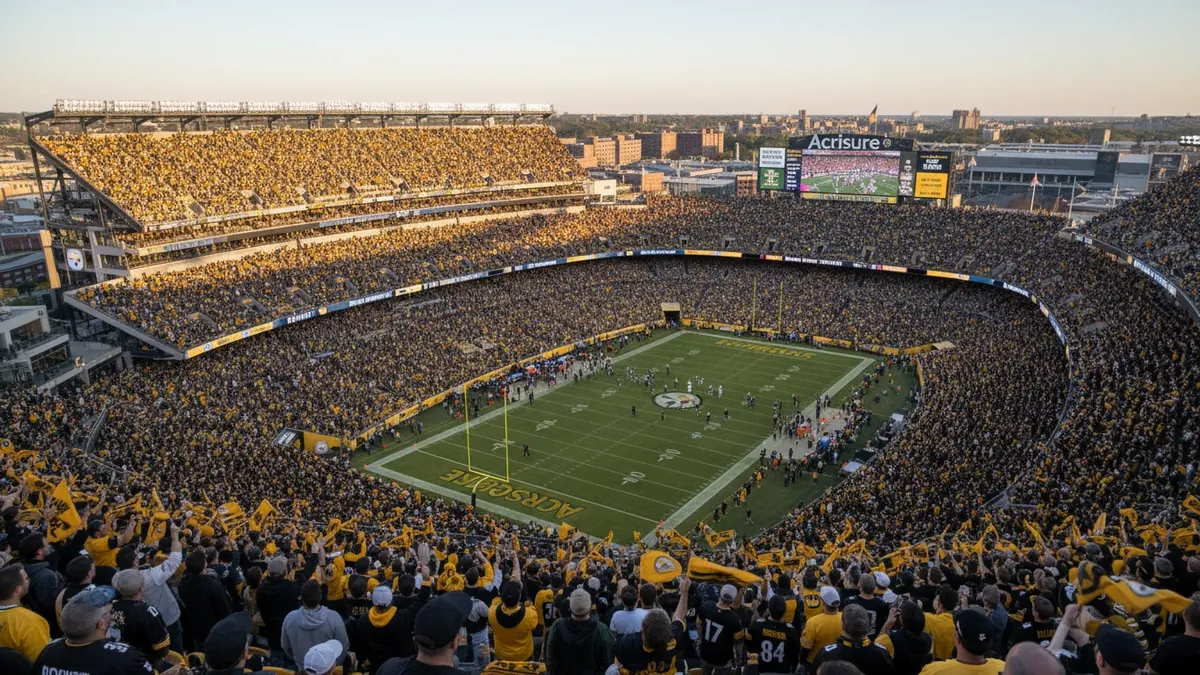
Steelers fans, known as "Steeler Nation," are among the most loyal and passionate in all of sports. Every home game since 1972 has been sold out, a streak that spans over half a century and reflects the deep connection between the team and the city. The most iconic symbol of this fandom is the Terrible Towel, created by broadcaster Myron Cope in 1975. When thousands of fans wave the yellow towels in unison at Acrisure Stadium, it creates a visual and psychological advantage that is unmatched in the NFL. The stadium, located at the confluence of the Allegheny, Monongahela, and Ohio rivers, provides a scenic backdrop for a brand of football that remains as gritty and industrial as the city itself. The "Black and Gold" culture extends far beyond Pittsburgh, with Steelers bars and fan clubs found in almost every major city in the world, making them one of the most well-supported teams in global sports. The atmosphere on game day in Pittsburgh is electric, a celebration of the city's identity and its love for the Steelers.
Legacy and Place in NFL History
The Pittsburgh Steelers' legacy is one of stability and excellence. While other teams go through cycles of boom and bust, the Steelers have remained relevant for over half a century. They are the model franchise for how to build a winning organization: through the draft, with patience, and by maintaining a clear identity. Whether it was the four titles in the 70s or the consistent winning seasons under Tomlin, the Steelers have proven that "The Steeler Way" works. They are not just a football team; they are a symbol of Pittsburgh’s resilience and a cornerstone of the NFL's global identity. Their impact on the league, from the "Rooney Rule" to their influence on defensive schemes, is profound and far-reaching. As they look toward the future, their goal remains the same: to continue the pursuit of excellence and to represent their city with pride, ensuring that the Steelers remain a dominant force in professional football for generations to come.
Conclusion
From the humble beginnings of the Rooney family’s "Pirates" to the six-time Super Bowl champions of today, the Pittsburgh Steelers' history is a journey of perseverance and triumph. They have defined multiple eras of professional football and produced some of the greatest legends to ever step onto the gridiron. As they move into the Mike McCarthy era in 2026, the goal remains the same: the pursuit of a seventh Lombardi Trophy. In Pittsburgh, the standard is the standard, and that standard is nothing less than greatness. The Steelers' story is one of family, tradition, and an unwavering commitment to being the best, ensuring that they will remain a powerhouse in the NFL for years to come. Their legacy is secure, but their ambition remains undiminished as they continue to write new chapters in their storied history.
Frequently Asked Questions (FAQ)
1. How many Super Bowls have the Steelers won?
The Pittsburgh Steelers have won six Super Bowl championships (IX, X, XIII, XIV, XL, and XLIII), which is tied for the most in NFL history.
2. Who is the most famous player in Steelers history?
While many players are legendary, Joe Greene is often cited as the most influential, while Franco Harris, Terry Bradshaw, and Ben Roethlisberger are among the most famous for their offensive contributions.
3. Why are they called the Steelers?
The team was renamed the Steelers in 1940 to honor the city's heritage as a major producer of steel.
4. Who is the current head coach of the Steelers?
As of early 2026, the head coach is Mike McCarthy, who succeeded Mike Tomlin after his 19-season tenure.
5. What is the "Terrible Towel"?
The Terrible Towel is a rally towel used by Steelers fans to show support during games, created by Myron Cope in 1975.