Pinehurst No. 2 History
Pinehurst No. 2, the centerpiece of the historic Pinehurst Resort in North Carolina, is a masterpiece of golf course architecture and a revered icon in American golf. Its rich Pinehurst No. 2 history is a testament to the genius of its designer, Donald Ross, and his philosophy of creating a challenging yet fair test of golf that harmonizes with the natural landscape. Since its opening in 1907, Pinehurst No. 2 has been a proving ground for the world's best golfers, hosting more major championships than any other course in the United States. Renowned for its crowned, undulating greens and strategic bunkering, the course demands precision, creativity, and a masterful short game. It is not just a golf course; it is a living embodiment of classic golf design, a place where the game's traditions are celebrated and its champions are forged.
The Vision of Donald Ross and the Birth of a Masterpiece

The story of Pinehurst No. 2 is inextricably linked with the life and career of Donald Ross, a Scottish immigrant who became one of the most influential golf course architects in American history. Ross arrived in Pinehurst in 1900, hired by the resort's founder, James Walker Tufts, to oversee the resort's burgeoning golf operations. While he initially worked on the resort's other courses, his ultimate vision was to create a championship course that would stand among the best in the world. This vision materialized in 1907 with the opening of Pinehurst No. 2.
Ross's design philosophy was rooted in the principles of the great links courses of his native Scotland, emphasizing strategic play, natural contours, and a variety of shot-making challenges. He believed that a course should be a fair test of golf, rewarding well-executed shots and penalizing poor ones, but always offering a path to recovery. Pinehurst No. 2 was his canvas, and he spent decades meticulously refining its layout, constantly tweaking bunkers, reshaping greens, and adjusting fairway lines. He famously said of No. 2, "It is the fairest test of championship golf I have ever designed." The course was built on sandy soil, which provided excellent drainage and a firm, fast playing surface, ideal for the ground game that Ross so admired. This initial design and Ross's continuous dedication laid the foundation for a course that would become a benchmark for classic American golf architecture.
Design Philosophy and the Famed Crowned Greens
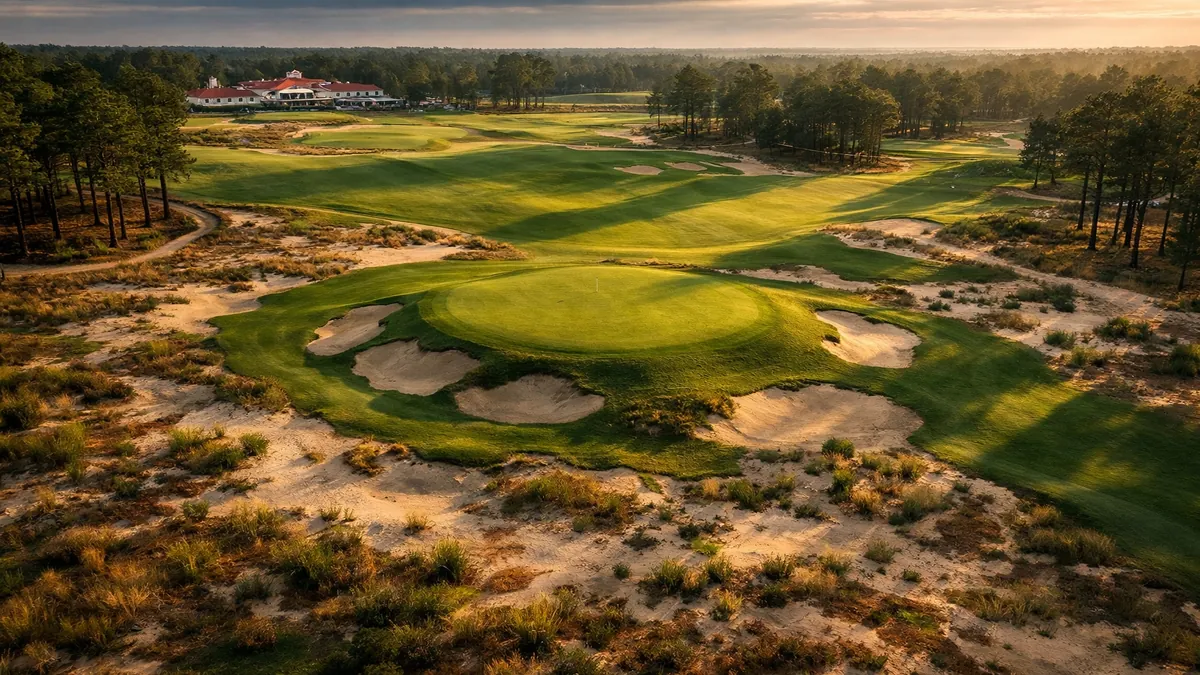
The defining characteristic of Pinehurst No. 2 is its famed crowned greens. These unique green complexes, often described as inverted saucers, are designed to repel all but the most precise approach shots, with balls that are not perfectly struck often rolling off the edges into collection areas. This design feature places an immense premium on accuracy and creativity around the greens, demanding a masterful short game to save par. The greens are not overly large, but their subtle undulations and slopes make putting a supreme test of touch and reading ability. Donald Ross believed that the challenge of a golf course should be found in its strategic elements rather than in penal hazards, and the crowned greens of No. 2 are a perfect embodiment of this philosophy.
Over its Pinehurst No. 2 history, the course has undergone several modifications, but the essence of Ross's design has always been preserved. In the 1970s, the course was overseeded with Bermuda grass, which altered its playing characteristics and led to a more modern, manicured look. However, in 2010, a major restoration project led by architects Bill Coore and Ben Crenshaw sought to return the course to its original, more natural state. They removed the Bermuda grass, re-established the sandy waste areas that had been a hallmark of Ross's design, and restored the natural contours of the fairways and greens. This restoration was widely praised for its authenticity and its success in bringing back the strategic challenges and aesthetic beauty of Ross's original vision. The course now plays as Ross intended, with firm, fast conditions that reward strategic thinking and a creative short game, ensuring its continued relevance as a championship venue.
Hosting Major Championships and Records

Pinehurst No. 2 has a storied history of hosting major championships, solidifying its reputation as one of golf's premier venues. It has been the site of three U.S. Opens, one PGA Championship, the Ryder Cup, and numerous other prestigious events. Its demanding layout and unique challenges have consistently produced memorable moments and deserving champions.
U.S. Open Championships at Pinehurst No. 2
- 1999 U.S. Open: The first U.S. Open held at Pinehurst No. 2 was won by Payne Stewart in dramatic fashion. Stewart made a 15-foot par putt on the 18th hole to defeat Phil Mickelson by one stroke, just months before his tragic death in a plane crash. His iconic victory pose, with one leg raised in celebration, is one of the most enduring images in U.S. Open history.
- 2005 U.S. Open: Michael Campbell, a relatively unknown qualifier from New Zealand, held off a charging Tiger Woods to win his only major championship. His steady play and clutch putting on the final day showcased the mental fortitude required to conquer Pinehurst No. 2.
- 2014 U.S. Open: Martin Kaymer delivered a dominant performance, winning by eight strokes with a wire-to-wire victory. His strategic brilliance and masterful control of the course, particularly on the challenging greens, set a new standard for excellence at Pinehurst.
- Payne Stewart's birdie in 1999 U.S. Open: Stewart's birdie on the 5th hole in the final round was a crucial moment in his battle with Phil Mickelson, showcasing his strategic play and clutch putting.
- Michael Campbell's birdie in 2005 U.S. Open: Campbell's birdie on the 17th in the final round was a key moment in his victory, giving him a cushion over Tiger Woods and demonstrating his nerve under pressure.
- Payne Stewart's winning putt (1999 U.S. Open): Stewart's 15-foot par putt on the 18th to win the U.S. Open is one of the most iconic moments in golf history. The image of his celebration is immortalized in a statue behind the 18th green.
Other Notable Events
Pinehurst No. 2 has also hosted the 1936 PGA Championship, won by Denny Shute, and the 1951 Ryder Cup, where the United States defeated Great Britain. It is also the home of the prestigious North & South Amateur Championship, one of the most important amateur events in the United States. The course's ability to consistently challenge the world's best, while providing a fair and strategic test, ensures its continued prominence in the golf world.
| Tournament | Year | Winner | Key Moment |
|---|---|---|---|
| 1936 PGA Championship | 1936 | Denny Shute | Victory in the match-play era |
| 1951 Ryder Cup | 1951 | USA | Dominant victory over Great Britain |
| 1999 U.S. Open | 1999 | Payne Stewart | 15-foot par putt on 18th to win |
| 2005 U.S. Open | 2005 | Michael Campbell | Held off Tiger Woods for an unexpected victory |
| 2014 U.S. Open | 2014 | Martin Kaymer | Dominant 8-stroke, wire-to-wire victory |
Famous Moments & Iconic Holes
Pinehurst No. 2 is a course where every hole presents a unique challenge, and its storied history is filled with famous moments that have unfolded on its iconic holes. The course's design, particularly its famed crowned greens, creates a theater for championship golf unlike any other.
The 5th Hole: A Strategic Par-5
This challenging par-5 requires two precise shots to set up a birdie opportunity. The green, like all at Pinehurst No. 2, is crowned and well-bunkered, demanding an accurate approach. It has been the scene of both eagles and disastrous bogeys, often playing a pivotal role in the outcome of championships.
The 17th Hole: A Demanding Par-3
This long par-3 is one of the most challenging on the course, with a large, undulating green that is difficult to hit and even more difficult to putt. It has been the scene of many dramatic moments, often coming at a crucial stage of the championship.
The 18th Hole: A Classic Finishing Hole
The par-4 18th is a classic finishing hole, with a narrow fairway and a well-guarded green. It has been the stage for some of the most memorable moments in U.S. Open history, often deciding the championship with the final putt.
These holes, and the moments they have produced, are integral to the mystique of Pinehurst No. 2, making every round a journey through golf history.
Legacy and Enduring Allure
Pinehurst No. 2 has forged a legacy as a true masterpiece of golf course architecture and a cornerstone of American golf. Its enduring allure stems from its timeless design, which has remained relevant and challenging for over a century, and its rich history of hosting major championships. The course stands as a testament to the genius of Donald Ross and his philosophy of creating a strategic, natural, and fair test of golf. The famed crowned greens, the sandy waste areas, and the subtle complexities of the layout combine to create a unique and unforgettable golfing experience.
Pinehurst No. 2 has played a crucial role in shaping the careers of golf's greatest champions, often serving as a defining moment in their professional lives. To conquer Pinehurst No. 2, particularly in a U.S. Open, is considered one of the ultimate achievements in golf, a testament to skill, creativity, and mental fortitude. The course's influence is also seen in its impact on golf course design, inspiring architects to create layouts that are both challenging and in harmony with their natural surroundings. It continues to inspire new generations of golfers and fans, maintaining its status as a beloved and revered venue that celebrates the true spirit of golf, where strategic thinking and a masterful short game are paramount.
FAQ: Pinehurst No. 2
Q: Who designed Pinehurst No. 2?
A: Pinehurst No. 2 was designed by the legendary golf course architect Donald Ross.
Q: What is the most famous feature of Pinehurst No. 2?
A: The most famous feature of Pinehurst No. 2 is its crowned, undulating greens, which repel all but the most precise approach shots.
Q: When did Pinehurst No. 2 officially open?
A: Pinehurst No. 2 officially opened in 1907.
Q: How many U.S. Opens has Pinehurst No. 2 hosted?
A: Pinehurst No. 2 has hosted three U.S. Opens.
Q: What was the significance of the 2010 restoration of Pinehurst No. 2?
A: The 2010 restoration, led by Bill Coore and Ben Crenshaw, returned the course to its original, more natural state, re-establishing the sandy waste areas and restoring the strategic challenges of Donald Ross's design.
References
[1] Pinehurst Resort. "Courses | Pinehurst No. 2." Pinehurst Resort. Available at: https://www.pinehurst.com/golf/courses/no-2/
[2] PGA Tour. "U.S. Open: Nine things to know about Pinehurst No. 2." PGA Tour, June 10, 2024. Available at: https://www.pgatour.com/article/news/needtoknow/2024/06/10/nine-things-to-know-pinehurst-no-2-124th-u-s-open