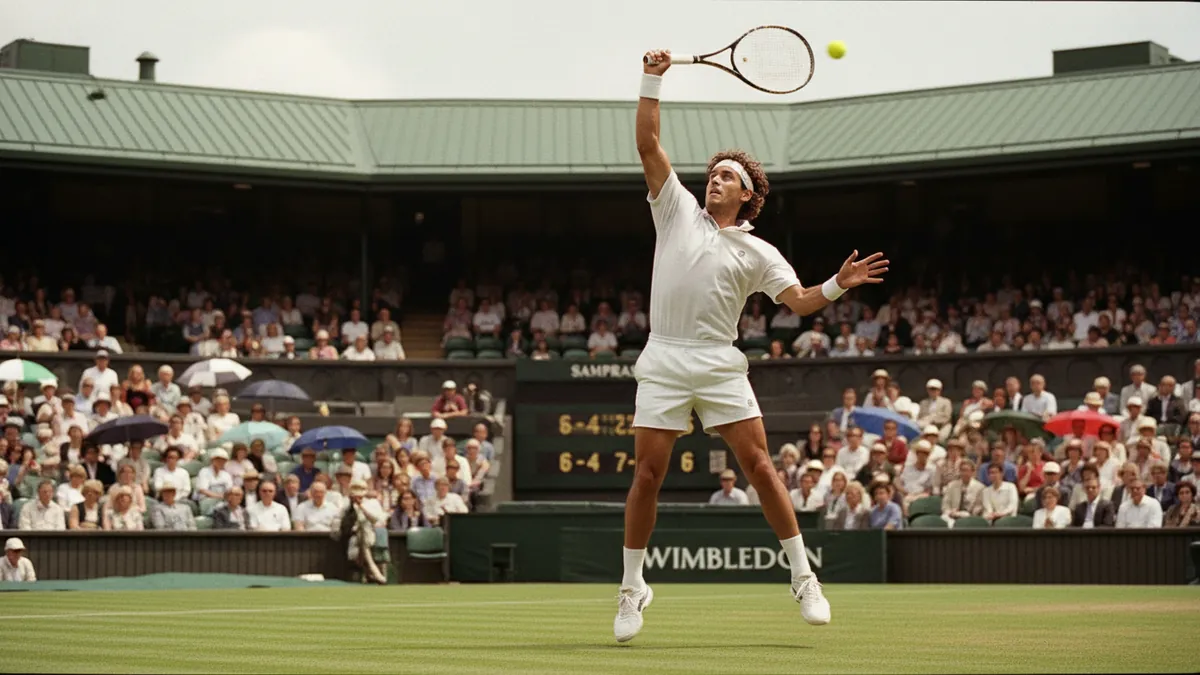
Pete Sampras Biography: The Greatest Server in Tennis History
Pete Sampras dominated men's tennis through the 1990s in a way that had not been seen since the era of Bjorn Borg. With 14 Grand Slam titles, six consecutive year-end world No. 1 finishes, and a serve widely considered the most effective weapon in the history of the game, Sampras defined an era.
Early Life and Development

Petros Sampras was born on August 12, 1971, in Washington, D.C., to Greek-American parents. The family later relocated to Palos Verdes, California, where the young Sampras was introduced to tennis at age seven by his father.
Coach Pete Fischer identified Sampras as a future champion when the boy was just 11 years old. Fischer made a controversial decision: he convinced the young Sampras to convert from a two-handed backhand to a one-handed backhand, believing the elegant shot would serve him better in the long run. He was right.
Fischer also installed the serve-and-volley game that would become Sampras's trademark — aggressive, efficient, and almost impossible to read.
Turning Pro and Early Career
Sampras turned professional in 1988 at age 16. His early results were modest, but by 1990 he was already a top-20 player. At the 1990 US Open, aged just 19, he announced himself to the world in spectacular fashion.
US Open 1990: The Arrival

Sampras won the 1990 US Open, defeating Ivan Lendl, John McEnroe, and Andre Agassi in the final. He became the youngest US Open men's champion ever at the time (a record since broken). His five-ace performance in the final was a preview of what was to come.
Wimbledon Dominance
Sampras and Wimbledon were made for each other. His serve-and-volley game, in an era when grass courts still played fast, was devastating. He won Wimbledon seven times: 1993, 1994, 1995, 1997, 1998, 1999, and 2000.
His grass court statistics are staggering. He lost only ten matches on grass in his entire career and won 95% of his Wimbledon matches. At his peak, his serve on grass was essentially an unsolvable puzzle — the ball arrived fast, heavy, and precisely placed before opponents could react.
The Serve
No discussion of Pete Sampras is complete without dwelling on his serve. It is widely considered the most technically perfect and tactically deployed serve in tennis history.
The components that made it unique:
- Disguise: Sampras's ball toss, racquet path, and hip rotation gave minimal indication of direction.
- Slice: His ability to curve the ball wide out of the deuce court created impossible angles.
- Kick serve: His second serve kicked away from opponents, reducing break point vulnerability.
- Mental use: He delivered his best serves in the highest-pressure moments, treating the toughest points as opportunities to end them immediately.
- Wimbledon: 7 titles (1993–95, 1997–2000)
- US Open: 5 titles (1990, 1993, 1995–96, 2002)
- Australian Open: 2 titles (1994, 1997)
- Roland Garros: 0 titles (his career weakness)
Ace counts in the thousands. Match-defining aces at critical moments. The serve was not just a shot — it was a weapon of match control.
The Sampras-Agassi Rivalry
The defining rivalry of Sampras's era was with Andre Agassi — a contrast in personality, style, and image that transcended tennis. Where Sampras was quiet, focused, and apparently disinterested in celebrity, Agassi was flamboyant, controversial, and culturally omnipresent.
On court, their matches were often classics. Sampras held the head-to-head edge overall, but Agassi beat him on clay and in crucial late-career encounters. The rivalry gave tennis a compelling narrative throughout the 1990s.
Grand Slam Record
Total Grand Slams: 14 (a record at the time of his retirement)
His 14 Grand Slam titles held the record for men's singles until Roger Federer surpassed it in 2009.
World No. 1
Sampras was year-end world No. 1 for six consecutive years: 1993–1998. This extraordinary run of consistency is matched in the modern era only by Novak Djokovic.
Roland Garros: The One That Got Away
Sampras never won the French Open, which prevented him from completing a Career Grand Slam. His game — serve-and-volley, built for fast surfaces — never fully translated to the slow red clay of Paris. He reached the semifinal three times but could not make the final.
This gap in his record has been used to argue against his claim to greatest of all time, but context matters: Sampras played in an era when surfaces were more extreme, and a clay specialist could equally be criticized for not winning on grass.
2002 US Open: The Fairytale Ending
Sampras's final Grand Slam title came at the 2002 US Open — his 14th and final major. He had been ranked outside the top 10 and was widely considered to be in decline. Instead he defeated Agassi in the final, playing some of the best tennis of his career. He retired at the following year's US Open, the perfect farewell.
Legacy
Pete Sampras's legacy is that of pure, relentless excellence. No wasted words, no drama, no distractions — just exceptional tennis played at the highest level for over a decade. His 14 Grand Slams, seven Wimbledon titles, and six consecutive year-end No. 1 rankings place him unquestionably among the three greatest male players in history.