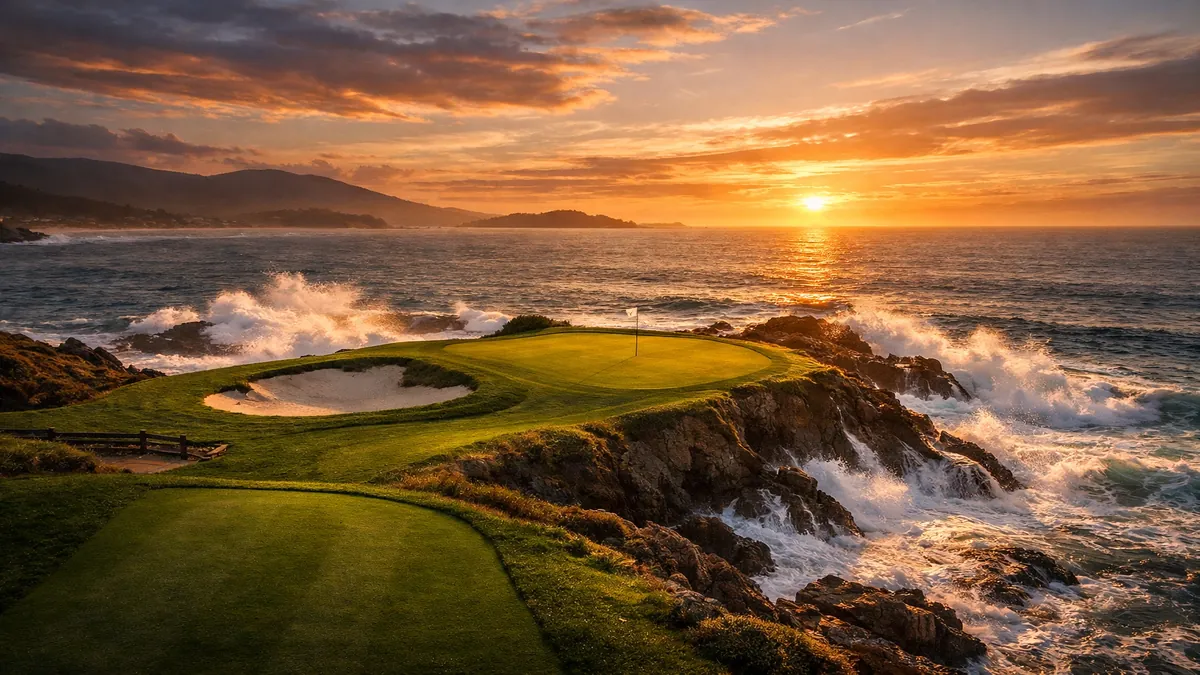
Pebble Beach Golf Links History
Pebble Beach Golf Links, perched majestically on the rugged coastline of the Monterey Peninsula in California, is widely regarded as one of the most beautiful and challenging golf courses in the world. Its rich Pebble Beach Golf Links history is a tapestry woven with breathtaking scenery, strategic design, and a legacy of hosting some of golf's most iconic tournaments, particularly the U.S. Open. Since its official opening in 1919, this legendary course has captivated golfers and fans alike with its dramatic oceanfront holes, demanding layout, and the unforgettable moments it consistently produces. Conceived with the audacious goal of placing as many holes as possible along the Pacific Ocean, Pebble Beach has not only achieved this but has also cemented its status as a hallowed ground in the sport, a true masterpiece where nature and golf coalesce.
The Visionary Origins and Early Development

The story of Pebble Beach Golf Links begins in the early 20th century, amidst the ambitious development plans for the Monterey Peninsula. The vision for a world-class golf course was primarily driven by Samuel F.B. Morse, a distant cousin of the inventor of Morse Code, who became the head of the Del Monte Properties Company in 1915. Morse recognized the unparalleled beauty and potential of the rugged coastline and envisioned a golf course that would serve as a centerpiece for the burgeoning resort community. His objective was clear: to design a course that maximized its ocean frontage, offering spectacular views and a challenging golfing experience.
To bring this vision to life, Morse enlisted two amateur golfers, Jack Neville and Douglas Grant, to design the course. Their amateur status, far from being a hindrance, allowed them a freedom of thought unconstrained by conventional architectural norms of the time. Neville and Grant shared Morse's ambition, and their primary directive was to lay out as many holes as possible along the dramatic Pacific coastline. Construction began in 1916, and Pebble Beach Golf Links officially opened for play on February 22, 1919. The initial design featured a layout that hugged the ocean for nine holes, a bold and innovative approach that immediately set it apart. The course was built on what was once a dense forest, requiring significant clearing and shaping to reveal the stunning ocean vistas that are now its hallmark. This foundational period established Pebble Beach not just as a golf course, but as an integral part of a luxurious resort experience, destined for greatness.
Design Philosophy and Course Evolution
The original design philosophy of Jack Neville and Douglas Grant for Pebble Beach Golf Links was groundbreaking: to utilize the natural contours of the land and the dramatic oceanfront to create a course that was both visually stunning and strategically demanding. They succeeded in crafting a layout where every hole presents a unique challenge, often requiring precise shot-making to navigate the narrow fairways, strategically placed bunkers, and the ever-present threat of the Pacific Ocean. The course is renowned for its small greens, which demand accuracy on approach shots, and its challenging par-3s and par-4s that hug the coastline.
Over its Pebble Beach Golf Links history, the course has undergone various modifications and refinements, though always with a deep respect for the original design and the natural environment. While Neville and Grant laid the initial foundation, subsequent architects and superintendents have contributed to its evolution. Alister MacKenzie, the renowned architect of Augusta National, offered his insights in the 1920s, suggesting minor tweaks. Robert Trent Jones Sr. made significant changes in the 1960s, particularly to the 5th and 17th holes, to prepare the course for its first U.S. Open. Jack Nicklaus, a four-time U.S. Open champion, also contributed to the redesign of the 5th hole in the late 1990s, transforming it into a spectacular oceanfront par-3. These changes have consistently aimed to maintain the course's challenge in the face of advancing golf technology, ensuring that Pebble Beach remains a formidable test for the world's best golfers. The meticulous preservation of its natural beauty, combined with strategic enhancements, has allowed Pebble Beach to retain its timeless appeal and its reputation as a true championship venue.
Hosting Major Championships and Records

Pebble Beach Golf Links has a storied history of hosting major championships, solidifying its reputation as one of golf's premier venues. It has been the site of six U.S. Opens, one PGA Championship, and numerous other prestigious events, including the annual AT&T Pebble Beach Pro-Am. The course's demanding layout and dramatic setting make it a favorite for both players and fans, consistently delivering memorable moments and crowning deserving champions.
U.S. Open Championships at Pebble Beach
- 1972 U.S. Open: The first U.S. Open held at Pebble Beach was won by Jack Nicklaus, who famously hit a 1-iron shot on the 17th hole that bounced off the flagstick, setting up a birdie that helped secure his victory. This marked the beginning of Pebble Beach's legacy as a U.S. Open venue.
- 1982 U.S. Open: Tom Watson famously chipped in for birdie on the 17th hole in the final round, snatching victory from Jack Nicklaus in one of the most iconic moments in U.S. Open history. This shot is replayed countless times and is a testament to the drama Pebble Beach can produce.
- 1992 U.S. Open: Tom Kite claimed his only major championship title with a masterful performance, navigating the challenging conditions to secure a two-stroke victory. His strategic play and precision were perfectly suited to Pebble Beach.
- 2000 U.S. Open: Tiger Woods delivered one of the most dominant performances in golf history, winning by a record 15 strokes. His performance was a masterclass in course management and ball-striking, showcasing his unparalleled talent on a course that had humbled many before him.
- 2010 U.S. Open: Graeme McDowell became the first European in 40 years to win the U.S. Open, holding off a strong field with a gritty final-round performance. His victory highlighted the international appeal and challenge of Pebble Beach.
- 2019 U.S. Open: Gary Woodland captured his first major championship, fending off Brooks Koepka with a clutch par on the 18th hole. His crucial birdie on the 17th hole in the final round was a defining moment.
- Tom Watson's birdie in 1982 U.S. Open: While his chip-in on 17 is more famous, Watson's birdie on the 7th in the final round of the 1982 U.S. Open was crucial in his battle with Jack Nicklaus, showcasing his aggressive play.
- Jack Nicklaus's assessment: Nicklaus famously called the 8th hole his favorite par-4 in golf, a testament to its strategic brilliance and natural beauty.
- Jack Nicklaus's 1-iron (1972 U.S. Open): Nicklaus's legendary 1-iron shot that hit the flagstick, setting up a birdie, is one of the most replayed shots from Pebble Beach. It demonstrated his precision under pressure.
- Tom Watson's chip-in (1982 U.S. Open): Watson's miraculous chip-in for birdie from the rough to beat Nicklaus is arguably the most famous shot in Pebble Beach history, a moment of pure magic.
- Tiger Woods's final walk (2000 U.S. Open): After his dominant performance, Woods's walk up the 18th fairway to secure his record-breaking victory is an enduring image of triumph at Pebble Beach.
Other Notable Events
Pebble Beach also hosted the 1977 PGA Championship, won by Lanny Wadkins in a playoff. Additionally, it has been a consistent host for the AT&T Pebble Beach Pro-Am, a popular PGA Tour event that combines professional and amateur play, attracting celebrities and showcasing the course annually. The course's ability to consistently challenge the world's best, while providing a stunning backdrop, ensures its continued prominence in the golf world.
| Tournament | Year | Winner | Key Moment |
|---|---|---|---|
| 1972 U.S. Open | 1972 | Jack Nicklaus | 1-iron off flagstick on 17th |
| 1977 PGA Championship | 1977 | Lanny Wadkins | Playoff victory |
| 1982 U.S. Open | 1982 | Tom Watson | Chip-in birdie on 17th to beat Nicklaus |
| 2000 U.S. Open | 2000 | Tiger Woods | Record 15-stroke victory |
| 2019 U.S. Open | 2019 | Gary Woodland | Clutch birdie on 17th, par on 18th to secure win |
Famous Moments & Iconic Holes
Pebble Beach Golf Links is a course where every hole tells a story, and its dramatic setting has been the backdrop for countless famous moments in golf history. The course's design, particularly its oceanfront holes, creates an unparalleled theater for championship golf.
The 7th Hole: "Dollie's"
This short par-3 is one of the most photographed holes in golf, plunging downhill to a tiny green perched on the edge of the Pacific Ocean. Despite its length, the wind can make it incredibly challenging, and it has been the scene of both brilliant birdies and disastrous scores.
The 8th Hole: "Lone Cypress"
Often cited as one of the greatest holes in golf, the par-4 8th requires a daring tee shot over a cove, followed by an approach shot to a green guarded by bunkers and the ocean. The views from this hole are spectacular, but the challenge is equally immense.
The 17th Hole: "Seal Rocks"
This iconic par-3, playing directly along the ocean, is renowned for its long tee shot over a cove to a hourglass-shaped green. It has been the stage for some of the most dramatic moments in U.S. Open history.
The 18th Hole: "Cypress"
The closing par-5 18th is one of the most famous finishing holes in golf, curving along the coastline with the Pacific Ocean guarding the entire left side. It offers a dramatic risk-reward opportunity, with eagles and double bogeys equally possible, making for thrilling finishes.
These holes, and the moments they have produced, are integral to the mystique of Pebble Beach, making every round a journey through golf history.
Legacy and Enduring Allure
Pebble Beach Golf Links has cultivated a legacy that extends far beyond the realm of golf, becoming a global icon of natural beauty and sporting excellence. Its enduring allure stems from a unique combination of factors: the breathtaking natural setting, where the Pacific Ocean serves as both a stunning backdrop and a formidable hazard; the strategic brilliance of its design, which challenges every aspect of a golfer's game; and the rich tapestry of history and legendary moments that have unfolded on its fairways and greens. The course's commitment to preserving its pristine environment, while consistently hosting major championships, has cemented its status as a bucket-list destination for golfers worldwide.
Pebble Beach has played a crucial role in shaping the careers of golf's greatest champions, often serving as a defining moment in their professional lives. To conquer Pebble Beach, especially in a U.S. Open, is considered one of the ultimate achievements in golf, a testament to skill, nerve, and adaptability. The course's influence is also seen in its impact on golf course design, inspiring architects to create layouts that harmonize with their natural surroundings. It continues to inspire new generations of golfers and fans, maintaining its status as a beloved and revered venue that celebrates the true spirit of golf, where the beauty of nature meets the challenge of the game.
FAQ: Pebble Beach Golf Links
Q: When did Pebble Beach Golf Links officially open?
A: Pebble Beach Golf Links officially opened for play on February 22, 1919.
Q: Who designed Pebble Beach Golf Links?
A: The course was designed by amateur golfers Jack Neville and Douglas Grant.
Q: How many U.S. Opens has Pebble Beach hosted?
A: Pebble Beach Golf Links has hosted six U.S. Opens.
Q: What is the most famous hole at Pebble Beach?
A: While many holes are iconic, the 7th (par-3), 8th (par-4), 17th (par-3), and 18th (par-5) are among the most famous, with the 17th often cited for its dramatic U.S. Open moments.
Q: What is the primary characteristic of Pebble Beach's design?
A: The primary characteristic is its dramatic oceanfront layout, with many holes playing directly along the rugged Pacific coastline, demanding strategic play and precision.
References
[1] Pebble Beach Company. "Pebble Beach Golf Links History." Pebble Beach Company. Available at: https://www.pebblebeach.com/golf/pebble-beach-golf-links/course-history/
[2] PGA.com. "Inside Pebble Beach Golf Links: History, Design and What Makes It Special." PGA.com, February 13, 2026. Available at: https://www.pga.com/story/inside-pebble-beach-golf-links-history-design-and-what-makes-it-special