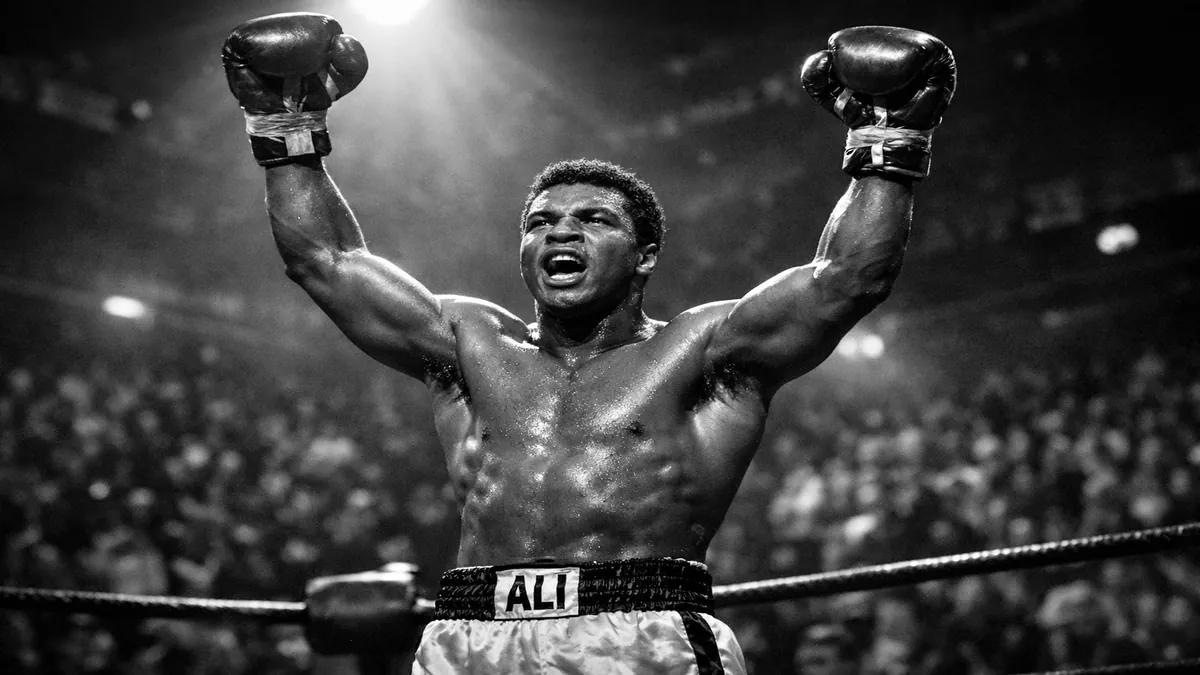
Muhammad Ali Biography: The Greatest of All Time
Muhammad Ali is not merely the greatest boxer in history — he is one of the most significant figures of the 20th century. Born Cassius Marcellus Clay Jr. on January 17, 1942, in Louisville, Kentucky, Ali transcended sport to become a symbol of courage, conviction, and defiance against injustice.
Early Life in Louisville

Ali grew up in a racially segregated Louisville in a working-class family. His father, Cassius Clay Sr., painted signs and murals. His mother, Odessa, worked as a household servant. The family was not poor but lived with the constant weight of Jim Crow segregation — second-class citizenship enforced by law and violence.
At 12, Ali's bicycle was stolen outside a fair. Furious, he reported it to a police officer named Joe Martin who also ran a boxing gym. Martin told the young boy that if he wanted to fight whoever stole his bike, he'd better learn how to fight. Ali took up the offer. Within weeks it was clear he was not an ordinary talent.
Amateur Career and the 1960 Olympics
Ali dominated amateur boxing in the late 1950s. He won six Kentucky Golden Gloves titles, two national Golden Gloves titles, and two Amateur Athletic Union national titles. His 100-5 amateur record tells only part of the story — his style was already revolutionary: dancing on his toes, pulling his head back from punches rather than blocking, throwing combinations at extraordinary speed.
At the 1960 Rome Olympics, aged 18, he won the light heavyweight gold medal, defeating fighters from Poland, the Soviet Union, and Australia. He returned home a hero — only to reportedly throw his gold medal into the Ohio River after being refused service at a Louisville restaurant despite his Olympic glory. (This story, whether literally true or symbolic, captured something essential about his experience of American racism.)
Early Professional Career

Ali turned professional in 1960 under the management of the Louisville Sponsoring Group — a consortium of white Louisville businessmen who recognized his commercial potential. He trained under Angelo Dundee, a relationship that would last through his entire career.
His early professional fights showcased his extraordinary speed and reflexes. He was already developing the style that would become his signature: the "Ali Shuffle," floating footwork, the ability to slip punches by moving his head, and devastating combination punching.
"I Am the Greatest" — The Liston Fights
Sonny Liston was the most feared man in boxing in 1963–64 — a ferocious puncher with underworld connections who had brutally destroyed Floyd Patterson twice. Almost nobody gave the 22-year-old Ali any chance.
Ali spent the weeks before the fight taunting Liston relentlessly, calling him "the big ugly bear," proclaiming himself "the greatest," and predicting round-by-round knockouts in rhyming verse. Sports journalists thought he was deluded. He was actually conducting psychological warfare.
On February 25, 1964, Ali won the heavyweight championship when Liston failed to answer the bell for the seventh round, apparently with an injured shoulder. Ali's joyous post-fight proclamation — "I am the greatest! I shook up the world!" — became one of sport's most famous moments.
The rematch in 1965 ended even more dramatically when Ali knocked Liston down in the first round with the famous "phantom punch." Whether Liston was legitimately knocked out or took a dive remains debated to this day.
Name Change and the Nation of Islam
The morning after the first Liston fight, Ali announced he had joined the Nation of Islam and was discarding his "slave name." He became Muhammad Ali. The announcement was seismic — in 1964 America, a young Black champion publicly rejecting Christianity and aligning with a Black nationalist organization was genuinely shocking to white America.
His friendship with Malcolm X, who was present at the first Liston fight, further alarmed the mainstream. Ali was unrepentant: "I don't have to be what you want me to be. I'm free to be what I want."
Vietnam War Refusal: "No Viet Cong Ever Called Me Nigger"
In 1967, Ali refused induction into the US Army, citing religious objections and opposition to the Vietnam War. His statement — "I ain't got no quarrel with them Viet Cong" — was widely reported, and his fuller elaboration: "No Viet Cong ever called me nigger" — became one of the defining political statements of the era.
The boxing authorities stripped him of his heavyweight title. He was convicted of draft evasion and sentenced to five years in prison (never served pending appeal). He was banned from boxing for three and a half years — from age 25 to 28, the prime years of an athlete's career.
The Supreme Court unanimously overturned his conviction in 1971. But the years away from the ring could never be recovered.
The Exile and Return
Ali lost three and a half years of his career during his boxing exile. When he returned in 1970, he was still a magnificent boxer but no longer the same explosive athlete. He had lost some speed. What he had gained was the ability to absorb punishment and fight from the inside — the skills that would define his greatest fights.
The Fight of the Century: Ali vs. Frazier I (1971)
Joe Frazier had won the heavyweight title during Ali's exile. Their first meeting — March 8, 1971, at Madison Square Garden — was billed as "The Fight of the Century." Both men were undefeated. Frazier won a unanimous 15-round decision, knocking Ali down in the 15th round with a massive left hook.
It was Ali's first professional defeat. The fight was brutal for both men — Frazier was hospitalized afterward. Three fights between these two warriors constitute one of the great rivalries in boxing history.
The Rumble in the Jungle (1974)
George Foreman had destroyed Frazier twice and was the most feared puncher in boxing. He was 25, at his physical peak. Ali was 32, a seven-to-one underdog. In Kinshasa, Zaire, before an African crowd that chanted "Ali, boma yé!" (Ali, kill him!), Ali unveiled the strategy that would become legendary.
The "rope-a-dope" — allowing Foreman to punch himself exhausted against Ali on the ropes — was not the plan going in (Dundee was horrified). But Ali absorbed the punishment, covered up, taunted Foreman, and waited. In the eighth round, when Foreman was exhausted, Ali came off the ropes and knocked him out. It remains one of the greatest upsets and most audacious tactical decisions in sports history.
The Thrilla in Manila (1975)
The third Ali-Frazier fight in Manila, Philippines, was described by Ali himself as the closest thing to dying he'd ever known. Fourteen rounds of ferocious, brutal combat in 40-degree heat. Ali won when Frazier's corner stopped the fight before the 15th round — Frazier was effectively blind in one eye.
Both men were never the same afterward. The fight was boxing at its most visceral and its most destructive.
Later Career and Parkinson's
Ali continued fighting past his prime, absorbing punishment that would have long-term consequences. His losses to Larry Holmes (1980) and Trevor Berbick (1981) were difficult to watch — a great champion diminished.
By 1984, he had been diagnosed with Parkinson's syndrome, likely related to the repeated head trauma of his career. He bore the disease with characteristic dignity. His lighting of the Olympic torch at the 1996 Atlanta Olympics — trembling hand holding the flame — was one of the most moving moments in Olympic history.
Legacy
Muhammad Ali died on June 3, 2016, in Scottsdale, Arizona, aged 74. The outpouring of grief was global. Presidents, kings, and ordinary people mourned together.
He was three-time heavyweight champion, 56-5 in professional boxing, an Olympic gold medalist, and the most recognizable face on earth for much of his career. But his legacy extends far beyond boxing — he was a man who stood for his principles at enormous personal cost, who used his platform to speak truth to power, and who embodied the possibility of athletic grace combined with moral courage.
"Float like a butterfly, sting like a bee" is a description of boxing. But Ali's full life — beautiful, controversial, courageous, and deeply human — belongs to history itself.