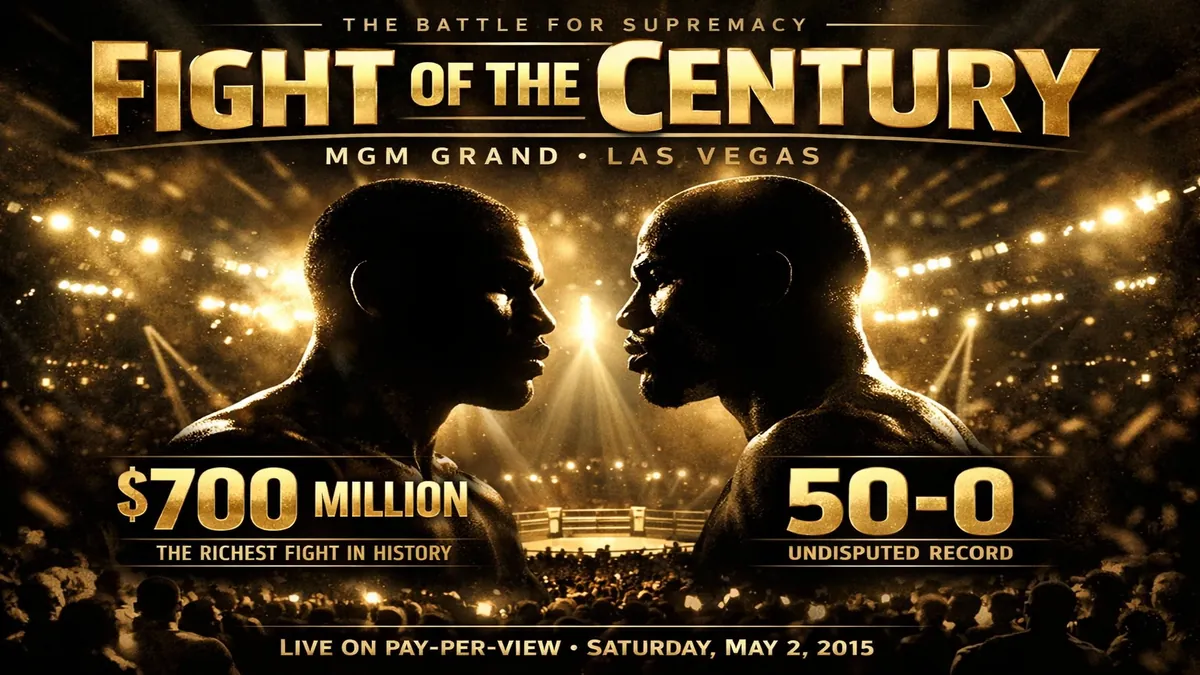
Mayweather vs. Pacquiao: The Fight of the Century (2015)
The Mayweather-Pacquiao fight on May 2, 2015, at the MGM Grand in Las Vegas generated more money than any event in the history of boxing and perhaps in the history of sport. As a commercial phenomenon, it was extraordinary. As a boxing match, it was polarizing — a technical masterpiece or a defensive exercise, depending on your perspective.
The Long Wait: 2009–2015

The fight people wanted to see was discussed for six years before it happened. In 2009, both Mayweather and Pacquiao were at the apex of their powers, and Top Rank promoter Bob Arum — who promoted Pacquiao — and Mayweather's team could not agree on terms.
Drug testing was the stated sticking point. Mayweather demanded Olympic-style blood testing; Pacquiao, who was needle-phobic, initially resisted. Negotiation collapses became an almost annual event.
By the time the fight was made for 2015, both men were on the descending slope of their careers. Mayweather was 38, Pacquiao was 36. The consensus among most boxing analysts was that they had both been quicker, sharper, and more dangerous five years earlier.
The Numbers: Commercial Magnitude
The fight generated:
- 4.6 million PPV buys — a boxing record
- $600 million+ in total revenue — a boxing record
- $72.2 million gate — MGM Grand arena's record
- Pay-per-view price: $100 (standard definition) to $150 (HD)
Celebrities, business leaders, and royalty attended ringside at prices reaching $150,000 per seat. The event became a cultural touchstone before the first punch was thrown.
The Fight

Pacquiao came forward from the opening bell, trying to close distance and land the left hand that had destroyed so many opponents. Mayweather executed his defensive game plan with clinical efficiency: shoulder roll, backward and lateral movement, clinching when Pacquiao got inside.
Rounds 1-6 were close, with Mayweather landing the cleaner shots but Pacquiao controlling moments of the action. From Round 7 onward, Mayweather began landing his right hand to the body and head with more regularity. Pacquiao's combinations were thrown but landed mostly on the guard.
The fight ended with Mayweather winning by unanimous decision: 116-112, 116-112, 118-110.
The Shoulder Controversy
Pacquiao had torn his right rotator cuff in training two weeks before the fight. The Nevada State Athletic Commission denied a pre-fight injection request, and the injury was not disclosed publicly. After the fight, when Pacquiao's team revealed the injury and he underwent surgery, the controversy became significant.
Many argued: would the fight have proceeded if the injury had been disclosed? Would the outcome have been different with a healthy Pacquiao? The Nevada commission subsequently fined Top Rank for the disclosure failure.
The Verdict from Boxing
Mayweather's supporters saw the fight as a technical masterpiece — a demonstration of the shoulder roll defensive system at its highest level. The point of boxing, they argued, is to hit and not be hit. Mayweather achieved this perfectly.
Pacquiao's supporters argued the fight was unwatchable — a fighter clinching his way to victory, moving away from every exchange, refusing to engage in the fighting that fans had paid to see.
The truth lies somewhere between these positions. Mayweather executed his game plan flawlessly. Pacquiao, hampered by injury and facing an opponent specifically built to neutralize his strengths, could not make the fight he wanted. The result was technically sound boxing that failed to deliver the dramatic, explosive combat that the enormous buildup had promised.
Legacy
The Mayweather-Pacquiao fight defined the commercial ceiling of boxing in the PPV era. No boxing match since has come close to its revenue figures. It was also, paradoxically, a moment that many point to as a turning point in boxing's mainstream relevance — the fight that sold itself on six years of hype and left many fans feeling let down, subsequently less invested in the sport's future events.