Joe Montana Biography: The Clutch Quarterback Who Defined a Dynasty
Who Is Joe Montana? (intro hook)

Joe Montana, affectionately known as "Joe Cool" and "The Comeback Kid," stands as one of the most iconic and revered figures in the history of American football. As the quarterback for the San Francisco 49ers for the majority of his illustrious career, Montana orchestrated an era of unprecedented dominance, leading the franchise to four Super Bowl championships in the 1980s. His calm demeanor under pressure, uncanny accuracy, and unparalleled ability to deliver in critical moments earned him a reputation as the ultimate clutch performer. Montana's legacy is not merely defined by his numerous accolades, including three Super Bowl MVP awards and two NFL MVP awards, but by his transformative impact on the quarterback position and the strategic evolution of the NFL. He epitomized precision passing, intelligent playmaking, and a winning mentality that inspired a generation of athletes and captivated millions of fans. His partnership with legendary coach Bill Walsh and wide receiver Jerry Rice created one of the most potent offensive attacks the league has ever seen, forever etching his name into the annals of sports history.
Early Life and Background
Joseph Clifford Montana Jr. was born on June 11, 1956, in New Eagle, Pennsylvania, a small town in the industrial Monongahela Valley. He grew up in the nearby town of Monongahela, where his father, Joe Montana Sr., worked as a loan officer and his mother, Theresa, managed the household. From a young age, Montana displayed a natural athleticism and a keen interest in sports. His father, a former high school football player, encouraged his son's athletic pursuits, often playing catch with him in the backyard and instilling in him a competitive spirit.
Montana attended Ringgold High School in Monongahela, where he excelled in multiple sports. He was a standout in football, basketball, and baseball, showcasing his versatility and natural talent. On the football field, he quickly emerged as a gifted quarterback, demonstrating an innate ability to read defenses and deliver accurate passes. His high school football coach, Chuck Abramski, recognized Montana's potential early on and helped him hone his skills. Beyond football, Montana was also a talented basketball player, earning a scholarship offer from North Carolina State University for basketball. However, his passion for football ultimately led him down a different path, setting the stage for his legendary career.
Early Career / College / Amateur Career

Despite his multi-sport talents, Joe Montana chose to pursue football, accepting a scholarship to the University of Notre Dame. His collegiate career, however, was not without its challenges. He spent his freshman year as the seventh-string quarterback and saw limited action during his sophomore season. It wasn't until his junior year, in 1977, that Montana truly began to shine. He led the Fighting Irish to a dramatic comeback victory against Purdue, earning him the starting job. This game was a precursor to many of his famous comeback performances.
The pinnacle of his college career came in the 1979 Cotton Bowl against the University of Houston. Trailing 34-12 in the fourth quarter, Montana, battling flu-like symptoms and hypothermia, led Notre Dame to an improbable 35-34 victory, throwing a touchdown pass on the final play of the game. This game, famously dubbed the "Chicken Soup Game" due to Montana consuming chicken soup on the sideline to combat his illness, cemented his reputation as a clutch performer. He finished his collegiate career with 4,121 passing yards and 26 touchdowns, leading Notre Dame to the 1977 National Championship. Despite his success, some NFL scouts questioned his arm strength and size, leading him to be a third-round pick in the 1979 NFL Draft.
Professional Career — San Francisco 49ers (1979-1992)
Joe Montana was drafted by the San Francisco 49ers as the 82nd overall pick in the 1979 NFL Draft. This selection, initially met with skepticism by some, would prove to be one of the most pivotal moments in franchise history. Under the guidance of head coach Bill Walsh, Montana quickly adapted to the innovative West Coast offense, a system that emphasized short, accurate passes and precise timing. After a rookie season with limited playing time, Montana took over as the starting quarterback in 1980, leading the 49ers to a respectable 6-10 record.
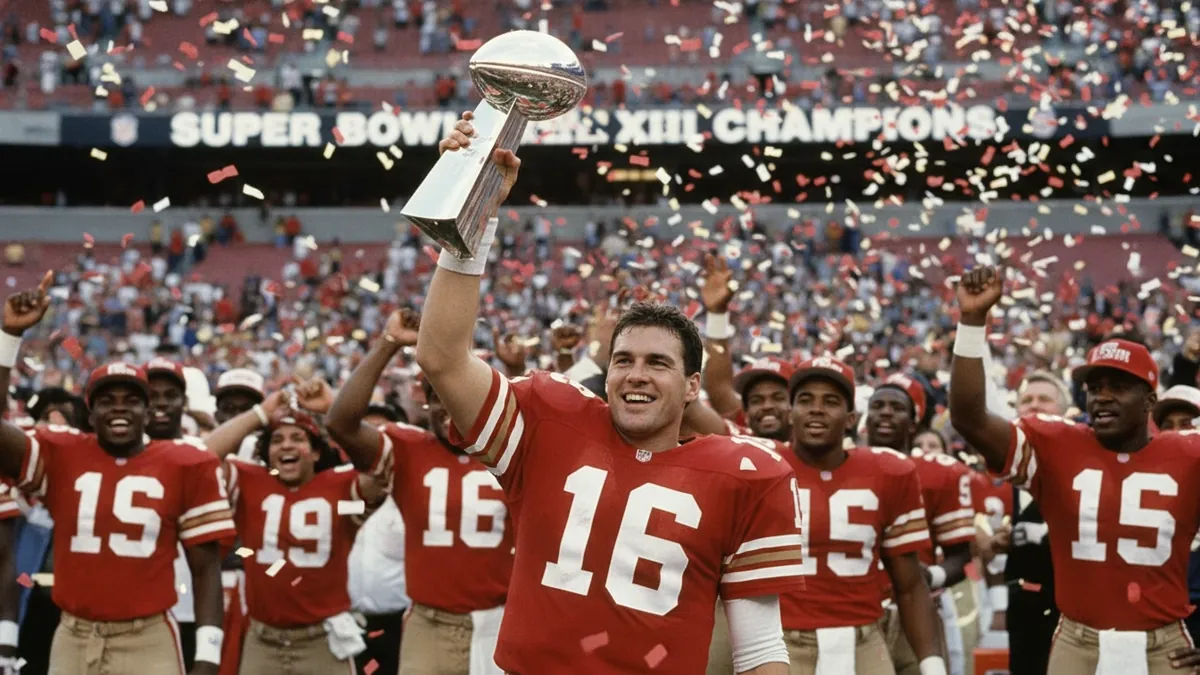
The 1981 season marked the beginning of the 49ers' dynasty. Montana, in only his third year, led the team to a 13-3 regular-season record and their first Super Bowl appearance. In Super Bowl XVI, he guided the 49ers to a 26-21 victory over the Cincinnati Bengals, earning his first Super Bowl MVP award. This championship was just the beginning. Montana would go on to lead the 49ers to three more Super Bowl titles: Super Bowl XIX (1985) against the Miami Dolphins, Super Bowl XXIII (1989) against the Cincinnati Bengals, and Super Bowl XXIV (1990) against the Denver Broncos. His performance in these Super Bowls was legendary, particularly his game-winning drive in Super Bowl XXIII, where he led the 49ers 92 yards down the field in the final minutes to secure the victory.
During his tenure with the 49ers, Montana formed an almost telepathic connection with wide receiver Jerry Rice, creating one of the most formidable quarterback-receiver duos in NFL history. Their ability to execute the West Coast offense with precision and flair made the 49ers a dominant force throughout the 1980s. Montana's calm demeanor in the huddle and his ability to make seemingly impossible plays became the hallmark of his career. He was named NFL MVP in 1989 and 1990, solidifying his status as the league's premier quarterback. However, injuries began to take their toll, and a severe elbow injury in 1991 sidelined him for most of that season and all of 1992, paving the way for Steve Young to emerge as the 49ers' starting quarterback.
Professional Career — Kansas City Chiefs (1993-1994)
After a storied career with the San Francisco 49ers, Joe Montana was traded to the Kansas City Chiefs in 1993. This move marked a new chapter in his career and provided him with an opportunity to prove he could still play at an elite level despite his age and injury history. In his first season with the Chiefs, Montana led the team to a 11-5 record and their first AFC Championship Game appearance since 1970. He famously led the Chiefs to a thrilling comeback victory against the Houston Oilers in the AFC Divisional Round, further cementing his reputation as "The Comeback Kid."
Montana's time with the Chiefs, though brief, was impactful. He brought a winning mentality and a wealth of experience to a franchise eager for postseason success. In 1994, his final season, he once again led the Chiefs to the playoffs, demonstrating flashes of his old brilliance. Despite not winning a Super Bowl with Kansas City, his presence elevated the team and provided fans with memorable moments. He retired from professional football after the 1994 season, leaving behind a legacy that transcended team loyalties.
Major Achievements and Records
Joe Montana's career is adorned with numerous individual and team achievements, solidifying his place among the NFL's all-time greats. His ability to perform at the highest level in the most critical moments is reflected in his unparalleled Super Bowl record.
- 4x Super Bowl Champion: Super Bowl XVI, XIX, XXIII, XXIV
- 3x Super Bowl MVP: Super Bowl XVI, XIX, XXIV
- 2x NFL MVP: 1989, 1990
- 8x Pro Bowl Selection: 1981, 1983, 1984, 1985, 1987, 1989, 1990, 1993
- 3x First-Team All-Pro Selection: 1987, 1989, 1990
- NFL 1980s All-Decade Team
- NFL 75th Anniversary All-Time Team
- NFL 100th Anniversary All-Time Team
- Inducted into the Pro Football Hall of Fame: 2000
Montana's Super Bowl record is particularly remarkable. He holds the record for the most Super Bowl passes without an interception (122) and was the first player to win three Super Bowl MVP awards. His four Super Bowl victories as a starting quarterback were a record at the time of his retirement, later surpassed by Tom Brady. These achievements highlight his consistent excellence on the biggest stage.
Playing Style and Strengths
Joe Montana's playing style was characterized by a unique blend of precision, poise, and an almost preternatural ability to perform under pressure. He wasn't known for a cannon arm or blazing speed, but rather for his surgical accuracy, intelligent decision-making, and unparalleled pocket presence. His ability to extend plays, step up in the pocket, and deliver accurate passes while under duress earned him the nickname "Joe Cool."
His greatest strength was his mental fortitude and his ability to remain calm in the most chaotic situations. This allowed him to consistently lead game-winning drives, often in the final minutes of a game. His vision and understanding of the West Coast offense were exceptional, enabling him to quickly read defenses and find open receivers. Montana's touch on the ball was legendary, allowing him to drop passes perfectly into his receivers' hands, even in tight windows.
Furthermore, Montana was a master of the pump fake, often freezing defenders and creating throwing lanes. He was also an underrated scrambler, capable of picking up crucial first downs with his legs when necessary. His leadership qualities were undeniable; teammates gravitated towards his calm confidence, especially when the stakes were highest. He was a quarterback who made everyone around him better, elevating the play of his receivers and inspiring his offensive line.
Career Statistics Overview
The following table provides a summary of Joe Montana's key career statistics, showcasing his consistent performance and efficiency throughout his 16 seasons in the NFL.
| Category | Career Total | Rank (All-Time) |
|---|---|---|
| Passing Yards | 40,551 | 20th (at retirement) |
| Passing Touchdowns | 273 | 11th (at retirement) |
| Completions | 3,409 | 10th (at retirement) |
| Pass Attempts | 5,391 | 12th (at retirement) |
| Completion Percentage | 63.2% | Top 10 (at retirement) |
| Passer Rating | 92.3 | Top 5 (at retirement) |
| Fourth Quarter Comebacks | 31 | Top 10 (at retirement) |
| Game-Winning Drives | 31 | Top 10 (at retirement) |
Personal Life
Joe Montana's personal life has been relatively private, though his celebrity status has naturally brought some aspects into the public eye. He has been married three times. His third marriage is to Jennifer Wallace, a former model and actress, whom he married in 1985. They have four children: Alexandra, Elizabeth, Nathaniel, and Nicholas. Both Nathaniel and Nicholas followed in their father's footsteps, playing college football as quarterbacks, though neither reached the NFL.
After retiring from football, Montana has remained involved in various business ventures and philanthropic efforts. He has been a spokesperson for numerous brands and has invested in several companies. He is also known for his passion for horses and has owned and bred several thoroughbreds. Despite his immense success and fame, Montana has maintained a reputation for being humble and approachable, often engaging with fans and participating in charity events. He resides in California, enjoying a life away from the intense spotlight of his playing days.
Legacy and Impact
Joe Montana's legacy is one of enduring greatness and profound impact on the game of football. He is widely credited with perfecting the West Coast offense, demonstrating how a precision passing game could dismantle even the most formidable defenses. His four Super Bowl victories with the 49ers established a dynasty that set a new standard for excellence in the NFL, influencing offensive strategies across the league for decades to come.
Beyond the championships, Montana's impact on the quarterback position itself is immeasurable. He showed that a quarterback didn't need to possess the strongest arm or the fastest legs to be successful; rather, intelligence, accuracy, and an unwavering belief in one's ability to perform under pressure were paramount. He became the archetype for the modern pocket passer, a master of timing and anticipation.
His calm demeanor in high-stakes situations earned him the moniker "Joe Cool" and made him a role model for aspiring quarterbacks. He taught the league that composure and execution in the clutch were more valuable than raw athleticism. Montana's iconic moments, from "The Catch" to his Super Bowl XXIII game-winning drive, are etched into the collective memory of NFL fans, serving as timeless examples of his legendary ability to deliver when it mattered most. He didn't just win games; he redefined how they were won, leaving an indelible mark on the sport.
Conclusion
Joe Montana's journey from a relatively overlooked college prospect to a four-time Super Bowl champion is a testament to his extraordinary talent, mental toughness, and unwavering dedication. His career with the San Francisco 49ers, marked by an unprecedented era of dominance, solidified his status as one of the greatest quarterbacks in NFL history. Montana's ability to remain calm and execute flawlessly in the most pressure-filled moments earned him the admiration of fans and peers alike, making "Joe Cool" a household name.
His partnership with Bill Walsh's West Coast offense revolutionized offensive football, emphasizing precision and timing that continues to influence the game today. While his statistics are impressive, it is his intangible qualities—his leadership, his composure, and his uncanny ability to lead game-winning drives—that truly define his legacy. Joe Montana didn't just play the game; he mastered it, leaving behind a blueprint for quarterback excellence that few have ever matched. His impact on the NFL is profound, and his place among the sport's immortals is secure.