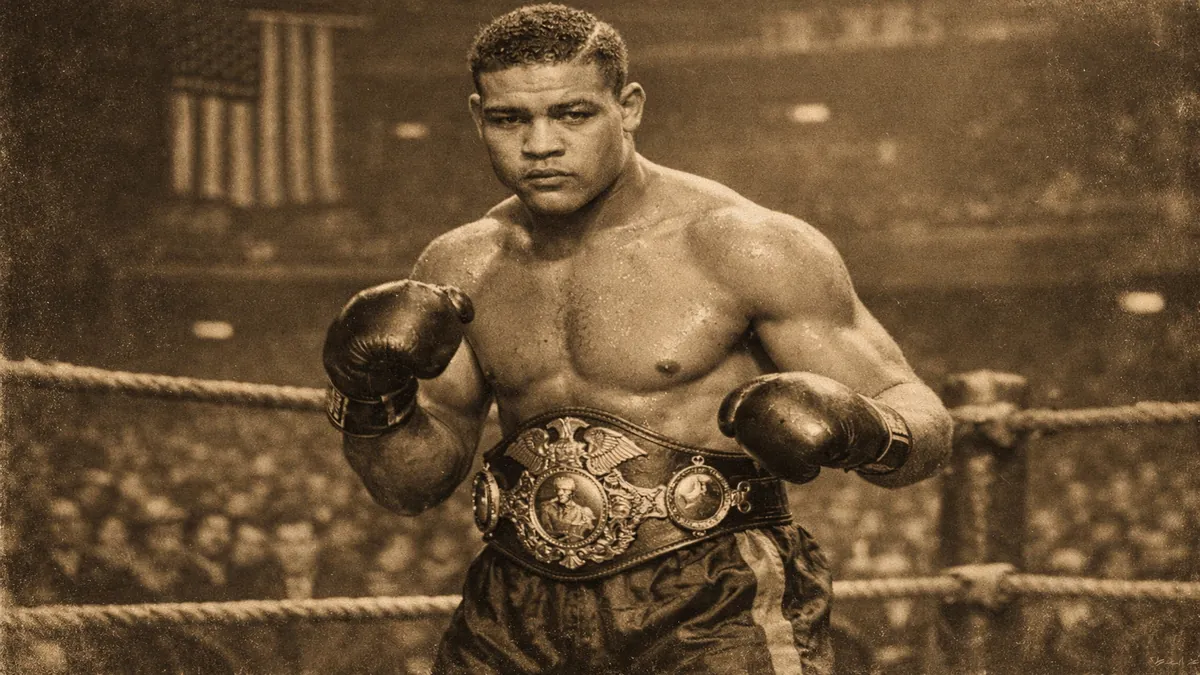
Joe Louis Biography: The Brown Bomber and America's Champion
Joe Louis was heavyweight champion of the world for 12 years — the longest reign in boxing history — and perhaps the most significant Black athlete in American history before Muhammad Ali. In a racially segregated America, he carried the weight of a community's pride on his shoulders in every fight.
Early Life

Joseph Louis Barrow was born on May 13, 1914, in Lafayette, Alabama. His family were sharecroppers — one of the most economically precarious positions in the American South — and moved to Detroit when Joe was 12, part of the Great Migration of Black Americans from the South to Northern industrial cities.
In Detroit, Louis began boxing in his teens and quickly showed exceptional ability. He trained at the Brewster Recreation Center under Holman Williams. By 1933, he was winning Golden Gloves competitions and attracting attention from professional promoters.
Professional Career and the Path to the Championship
Louis turned professional in 1934 and won his first 27 fights, 23 by knockout. The one defeat of his early career — a controversial 12th-round knockout by Max Schmeling of Germany in 1936 — was followed by a sustained run of victories that earned him the right to fight for the title.
On June 22, 1937, Louis defeated James Braddock in Chicago to become heavyweight champion of the world at 23 years old. He was the first Black heavyweight champion since Jack Johnson's reign ended in 1915.
The Schmeling Rematch: More Than Boxing

The rematch with Max Schmeling on June 22, 1938, was one of the most politically charged sporting events in history. Schmeling was German — not a Nazi himself, and he had a Jewish manager — but he was being used by Joseph Goebbels's propaganda apparatus as a symbol of Aryan superiority. Adolf Hitler personally telegraphed his support.
Louis knocked Schmeling out in two minutes and four seconds of the first round, one of the most dominant championship performances ever. The reaction in Black America was an explosion of joy — in Harlem, Detroit, Chicago, and across the country, people celebrated in the streets.
For many Americans, both Black and white, the fight became a proxy for America versus fascism. Louis was suddenly not just a Black champion but the American champion.
The Long Reign: 25 Title Defenses
Louis defended his title 25 times — more than any heavyweight champion in history. He fought (and defeated) what boxing journalists called the "Bum of the Month Club" during 1941: a series of mandatory challengers who were not in his class.
His most celebrated victories were against Billy Conn, who nearly defeated him. Conn was lighter, faster, and was winning on points through 12 rounds when he inexplicably decided to go for the knockout rather than box his way to a decision victory. Louis caught him and stopped him in the 13th.
Military Service and Retirement
Louis entered the US Army in 1942 and served throughout World War II, including fighting exhibition matches to boost morale. He donated his purses from two title fights to the Army and Navy Relief Funds — acts of generosity that, combined with his patriotic service, made him beloved across racial lines in wartime America.
He retired in 1949 with a 66-3 record. Financial difficulties — partly caused by tax issues stemming from his wartime donations and the IRS's refusal to forgive the accumulated back taxes — brought him out of retirement for the ill-fated Ezzard Charles fight (1950, lost on points) and the Rocky Marciano fight (1951, stopped in eight rounds).
Legacy
Joe Louis died on April 12, 1981, in Las Vegas. He was 66.
His legacy encompasses sport and history simultaneously. In a segregated America that denied Black citizens basic civil rights, Louis provided something that went beyond entertainment: dignity, pride, and proof. His careful management of his public image — advised always to be polite, never to gloat over white opponents — reflected the impossible position of a Black man required to be both exemplary and non-threatening.
Muhammad Ali explicitly rejected this expectation. But it was Louis who bore it first, and bore it without complaint, for over a decade. The 12-year heavyweight championship reign, the 25 title defenses, and the Schmeling knockout establish him among the five greatest heavyweights in history.