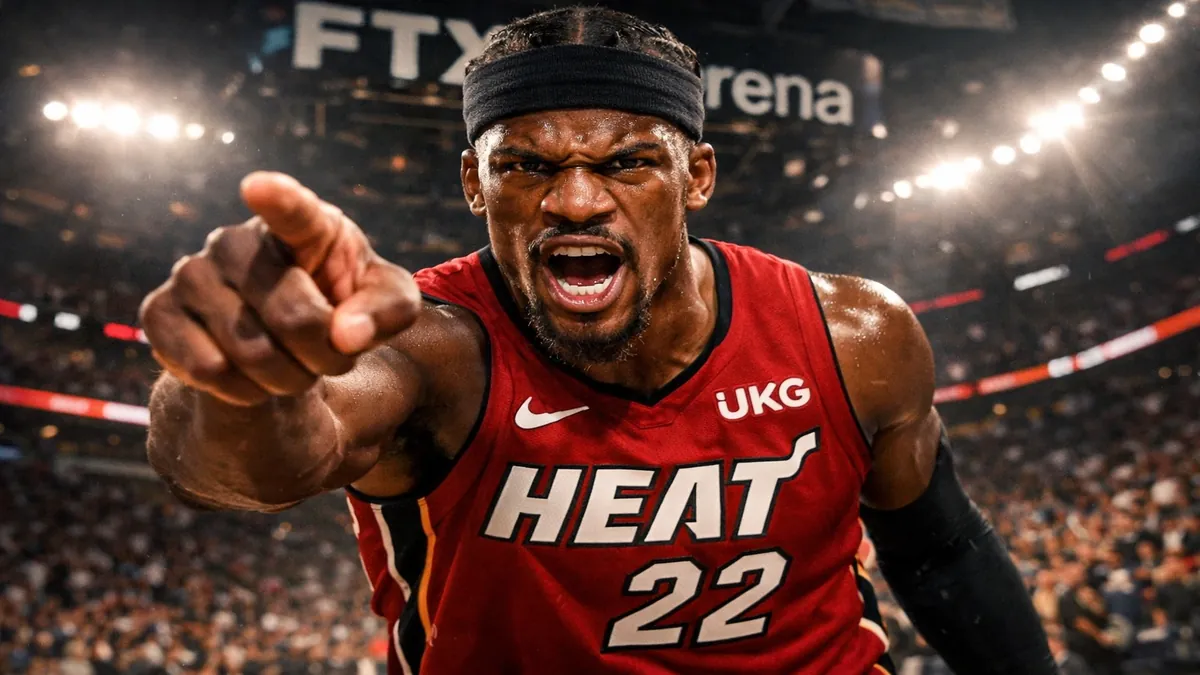
Jimmy Butler Biography: Nobody Gave Him Anything: The Most Improbable All-Star in NBA History
In the world of professional sports, narratives are often built around prodigies—the "chosen ones" who were destined for greatness from the moment they first picked up a ball. These are the players who dominate high school, become household names in college, and are drafted at the top of their class with multi-million dollar contracts waiting for them. Jimmy Butler is not one of those players. His story is not one of destiny, but of defiance. It is the most improbable and extraordinary human narrative in modern basketball, a tale of a young boy who was abandoned by his family, who couch-surfed his way through his teenage years, and who was drafted 30th overall as an afterthought. Yet, through sheer force of will, he transformed himself into a perennial All-Star, a franchise cornerstone, and one of the most feared competitors in the National Basketball Association.
TThe central tension of Jimmy Butler's career is the chasm between where he started and where he is now. He is a player who was given nothing and earned everything. His journey from homelessness to the NBA Finals is a testament to the power of resilience, the importance of found family, and the unquantifiable impact of a "dog" mentality. He is the ultimate underdog, the player who wants to be counted out, because it gives him a reason to prove everyone wrong.
The Night His Mother Said Leave

The story of Jimmy Butler begins in Tomball, Texas, a small town outside of Houston. For many, childhood is a time of security and support, but for Jimmy, it was a time of instability and eventually, abandonment. At the age of 13, his mother famously told him, "I don't like the look of you. You gotta go." With those words, Jimmy was thrust into a world of homelessness. He didn't have a permanent address for years, moving from house to house, sleeping on the couches of friends and teammates.
This experience would have broken most children, but for Jimmy, it was the foundation of his legendary toughness. He learned early on that he couldn't depend on anyone but himself. He had to be "useful" to the families that took him in, often helping with chores and staying out of trouble just to have a roof over his head. This period of his life is often glossed over in highlight reels, but it is the key to understanding his "Mamba-like" intensity. He plays every game as if his livelihood depends on it, because at one point, it literally did.
A New Family, A New Future
The turning point in Jimmy's life occurred during his senior year of high school. He met Jordan Leslie, a freshman football and basketball player, and the two became fast friends. Despite having seven children of her own, Jordan's mother, Michelle Lambert, eventually welcomed Jimmy into their home. They didn't just give him a place to sleep; they gave him a family. Michelle gave him a set of rules: "Stay out of trouble, do your schoolwork, and be a role model for the younger kids."
This was the first time Jimmy had a stable environment, and his basketball game began to reflect that stability. He wasn't a top-tier recruit; he wasn't even ranked by the major scouting services. He ended up at Tyler Junior College, where he averaged 18.1 points per game. His performance caught the eye of Buzz Williams, the head coach at Marquette University. Williams was known for his "tough-love" coaching style, and he saw in Jimmy a player who could handle the pressure.
At Marquette, Jimmy wasn't the star. He was a "role player" who did the dirty work—rebounding, defending the opponent's best player, and hitting the occasional open shot. He averaged just 5.6 points per game in his first season at Marquette. But his work ethic was legendary. He was the first one in the gym and the last one to leave. By his senior year, he had improved his scoring to 15.7 points per game and was named an All-Big East Honorable Mention. He was a "glue guy" who made winning plays, the kind of player that coaches love but scouts often overlook.
Pick 30: Chicago and Tom Thibodeau

The 2011 NBA Draft was a deep class, featuring stars like Kyrie Irving and Kawhi Leonard. Jimmy Butler's name wasn't called until the very end of the first round, when the Chicago Bulls selected him with the 30th overall pick. At the time, the Bulls were one of the best teams in the league, led by the youngest MVP in history, Derrick Rose, and coached by the defensive mastermind Tom Thibodeau.
Thibodeau and Butler were a match made in basketball heaven. Both were "basketball junkies" who valued defense and effort above all else. In his rookie season, Jimmy barely played, averaging only 8.5 minutes per game. But he spent that time learning from veterans like Luol Deng and Joakim Noah. He studied their defensive rotations and their preparation. When Luol Deng went down with an injury in the 2012-13 season, Jimmy was ready. He played all 48 minutes in several playoff games, hounding LeBron James and proving that he belonged on the big stage.
| Season | Points Per Game (PPG) | Minutes Per Game (MPG) | All-Star Selection | ||
|---|---|---|---|---|---|
| 2011-12 | 2.6 | 8.5 | No | ||
| 2012-13 | 8.6 | 26.0 | No | ||
| 2013-14 | 13.1 | 38.7 | No | ||
| 2014-15 | 20.0 | 38.7 | Yes (MIP) | ||
| Game | Points | Rebounds | Assists | Minutes | Result |
| Game 3 | 40 | 11 | 13 | 45 | Win |
| Game 5 | 35 | 12 | 11 | 47 | Win |
| Achievement | Jimmy Butler | Typical 30th Pick | |||
| All-Star Appearances | 6 | 0.4 | |||
| All-NBA Selections | 5 | 0.1 | |||
| NBA Finals Starts | 11 | 0.2 | |||
| Career PPG | 18.3 | 6.5 |
As the table above shows, Jimmy Butler has outperformed every expectation placed upon him. He is the most improbable All-Star in NBA history. He is a reminder that in basketball, as in life, it's not about where you start, but how you finish. He is "Jimmy Buckets," the man who was given nothing and took everything. He is the ultimate proof that "Heat Culture" isn't just a marketing slogan; it's a way of life. And for a kid from Tomball who once had nowhere to sleep, the bright lights of the NBA Finals are a long way from home, but they are exactly where he belongs. He continues to play with that same chip on his shoulder, a player who knows that no matter how much he achieves, he will always be the kid that nobody wanted. And that is exactly how he likes it.