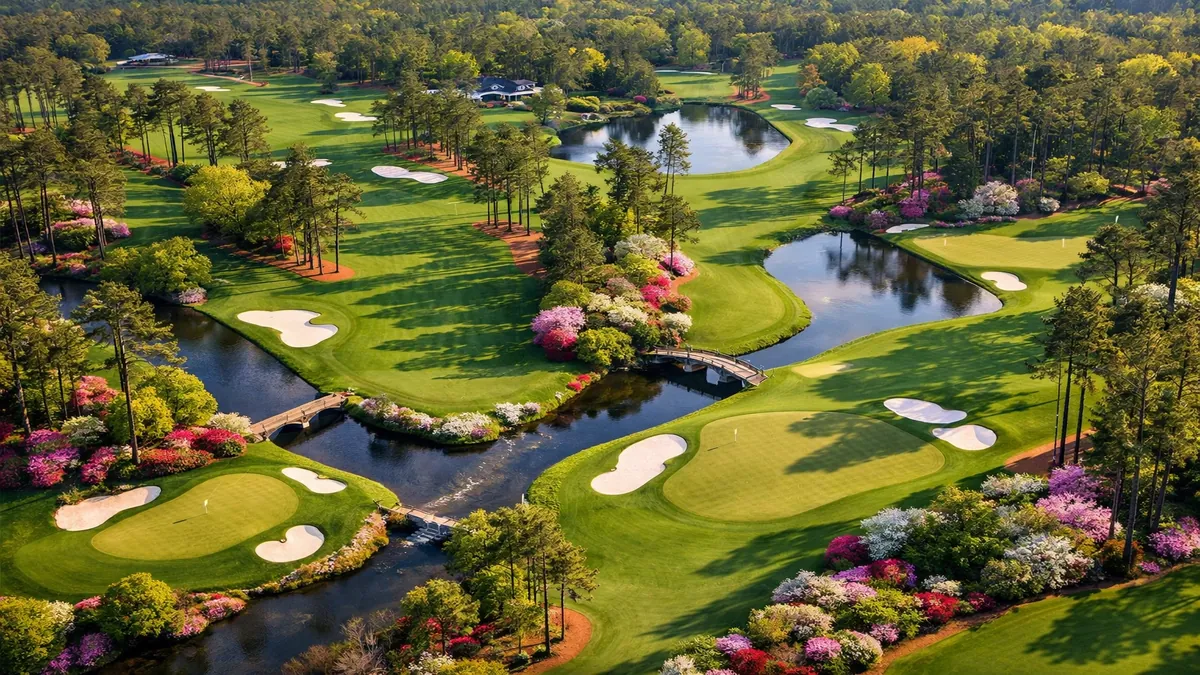
Augusta National Golf Club History
Augusta National Golf Club, nestled in Augusta, Georgia, is arguably the most famous and revered golf course in the world. Its history is inextricably linked with The Masters Tournament, the only major championship held annually at the same venue. Conceived by amateur golf legend Bobby Jones and visionary investment banker Clifford Roberts, Augusta National was designed to be a golf course unlike any other—a challenging yet beautiful layout that would test the game's elite while offering an unparalleled experience. Since its opening in 1932, it has evolved into a symbol of excellence, tradition, and exclusivity in the sport, captivating millions with its pristine conditions, blooming azaleas, and the dramatic moments it consistently produces. The club's unique design, coupled with its storied past, has cemented its status as a hallowed ground in golf.
The Visionary Founders and the Birth of a Legend

The story of Augusta National Golf Club begins with the extraordinary partnership of Bobby Jones and Clifford Roberts. Following his unprecedented Grand Slam in 1930, Jones, at the pinnacle of his amateur career, retired from competitive golf. His dream was to create a golf course where he could host an annual tournament for his friends and fellow golf enthusiasts. Roberts, a shrewd New York investment banker, shared Jones's vision and provided the financial acumen and organizational drive necessary to bring it to fruition. Together, they found a suitable piece of land in Augusta, Georgia—a former indigo plantation known as Fruitland Nurseries, which offered ideal terrain for a golf course.
Jones collaborated with the renowned English golf course architect Alister MacKenzie, whose philosophy aligned perfectly with Jones's desire for a course that was strategic, natural, and challenging for the best players while still being enjoyable for the average golfer. MacKenzie, known for his work at Cypress Point and Royal Melbourne, embraced the natural contours of the land, incorporating existing creeks, hills, and trees into the design. Construction began in 1931, and the course officially opened in December 1932. The initial tournament, first played in 1934, was originally known as the Augusta National Invitation Tournament, but it quickly became known as The Masters, a name that perfectly captured the founders' ambition for a championship of the highest caliber. Jones and Roberts meticulously oversaw every detail, from the course layout to the club's exclusive membership policies, laying the foundation for its enduring mystique and prestige.
Design Philosophy and Course Evolution
Alister MacKenzie's design for Augusta National was revolutionary for its time, emphasizing strategic play over penal hazards. His philosophy, heavily influenced by the great links courses of Scotland, focused on creating wide fairways that offered multiple lines of play, rewarding thoughtful shot-making and penalizing poor decisions. The course was designed to be a
second-shot golf course, where approach shots to the greens were paramount. The greens themselves were designed with subtle undulations and slopes, making putting a supreme test of touch and reading ability. MacKenzie famously said, "The ideal golf course is one that requires the player to use every club in his bag, and every shot in his repertoire." Augusta National embodies this principle.
Over its history, Augusta National has undergone numerous modifications and enhancements, often in response to advancements in golf technology and player skill. While the core design principles have been preserved, the course has been lengthened, bunkers have been reshaped, and trees have been strategically planted to maintain its challenge. Legendary golf architect George W. Cobb began a long association with the club, making significant alterations to greens and fairways. Later, figures like Robert Trent Jones Sr., Jack Nicklaus, and Tom Fazio have also contributed to the course’s evolution, always under the watchful eye of the club’s leadership, ensuring that Augusta National remains a formidable test for the world’s best golfers. These changes, often subtle but impactful, are meticulously planned to preserve the integrity of MacKenzie and Jones’s original vision while adapting to the modern game. The club’s commitment to perfection extends to its immaculate conditioning, with every blade of grass and every flower meticulously cared for, creating a visually stunning backdrop for The Masters.
Famous Moments & Iconic Holes

Augusta National Golf Club is not just a golf course; it is a living museum of golf history, where countless famous moments have unfolded, often on its iconic holes. These holes, with their unique challenges and strategic demands, have become synonymous with the drama and excitement of The Masters Tournament.
Amen Corner (Holes 11, 12, and 13)
Perhaps the most famous stretch of holes in golf, Amen Corner comprises the second shot on the 11th, the entire 12th, and the first two shots on the 13th. This trio of holes is renowned for its beauty and its brutality, often playing a pivotal role in deciding the Masters champion. The 11th, a long par-4, features a pond guarding the green. The 12th, a short par-3 known as "Golden Bell," is arguably the most famous par-3 in golf, with Rae's Creek in front and swirling winds making club selection notoriously difficult. The 13th, a picturesque par-5 named "Azalea," offers a risk-reward opportunity, with a creek running along the left side of the fairway and guarding the green. Many Masters have been won and lost in Amen Corner, making it a place of both triumph and heartbreak.
- Larry Mize's chip-in on 11 (1987): In a sudden-death playoff against Greg Norman, Augusta native Larry Mize hit a miraculous chip shot from well right of the 11th green that rolled in for birdie, securing his only Masters title. This moment is a classic example of the magic that can happen at Amen Corner.
- Fred Couples's ball defying gravity on 12 (1992): In 1992, Fred Couples's tee shot on the 12th appeared destined for Rae's Creek, but it miraculously clung to the bank, allowing him to chip up and save par, ultimately leading to his Masters victory. This moment is often cited as an example of the "Augusta bounce" or divine intervention.
- Tiger Woods's chip-in on 16 (2005): In one of the most replayed shots in golf history, Tiger Woods hit a seemingly impossible chip shot from the fringe of the 16th green. The ball slowly trickled down the slope, paused tantalizingly on the lip of the cup, and then dropped in for birdie. This shot, and the subsequent celebration, became an instant classic and helped Woods win his fourth Masters title.
- Jack Nicklaus's final putt (1986): After his legendary charge on the back nine, Jack Nicklaus sealed his sixth Masters victory with a par on the 18th. The roar of the crowd as his putt dropped is one of the most iconic sounds in golf history, solidifying his status as the greatest Masters champion.
The 16th Hole: "Redbud"
The par-3 16th hole, known as "Redbud," is another iconic hole at Augusta National, famous for its dramatic Sunday pin positions and the potential for late-tournament heroics. A large pond guards the left side of the green, making a precise tee shot essential. The green itself features significant undulations, creating challenging putts.
The 18th Hole: "Holly"
The par-4 18th hole, "Holly," provides a dramatic closing to the Masters Tournament. With its uphill tee shot, narrow fairway, and two bunkers guarding the green, it has been the scene of countless nerve-wracking finishes. The walk up the 18th fairway, lined by cheering patrons, is one of the most iconic scenes in golf.
These holes, and the moments they have produced, are integral to the mystique of Augusta National, making every Masters Tournament a potential stage for new legends to be born.
Legacy and Enduring Mystique
Augusta National Golf Club has cultivated a legacy that transcends the sport of golf, becoming a global icon of sporting excellence and tradition. Its enduring mystique stems from a deliberate commitment to exclusivity, meticulous preservation of its natural beauty, and an unwavering dedication to providing the ultimate stage for The Masters Tournament. The club operates under its own unique set of rules and customs, from the limited number of commercial breaks during broadcasts to the polite term "patrons" for its spectators, all contributing to an atmosphere of reverence and respect.
The club’s influence extends beyond the tournament itself, impacting golf course design, agronomy, and the overall presentation of professional golf. It has inspired countless architects and superintendents to strive for similar levels of perfection, even if its resources and unique environment are unparalleled. Augusta National remains a private club for the majority of the year, opening its gates to the world only for The Masters, which further enhances its allure and desirability. The Green Jacket, awarded to the Masters champion, is not just a garment but a symbol of belonging to an elite fraternity, a testament to conquering one of golf’s most demanding and beautiful challenges. The club continues to evolve, subtly adapting to the modern game while fiercely protecting the core values and traditions that have made it a hallowed ground in the world of sports.
FAQ: Augusta National Golf Club
Q: Who founded Augusta National Golf Club?
A: Augusta National Golf Club was founded by amateur golf legend Bobby Jones and investment banker Clifford Roberts.
Q: Who designed the golf course at Augusta National?
A: The course was designed by Bobby Jones in collaboration with renowned English golf course architect Alister MacKenzie.
Q: What is "Amen Corner" at Augusta National?
A: Amen Corner refers to the challenging and iconic stretch of holes 11, 12, and 13 at Augusta National, known for their beauty and difficulty.
Q: When did Augusta National Golf Club officially open?
A: Augusta National Golf Club officially opened in December 1932.
Q: What is the significance of the 17th hole at Augusta National?
A: While the 17th is a par-4, the question likely refers to the famous 12th hole (Golden Bell) or the 16th hole (Redbud) for their dramatic moments. The 17th is known for its challenging green and the Eisenhower Tree that once stood there.
References
[1] Masters.com. "About the Tournament." Masters.com. Available at: https://www.masters.com/en_US/tournament/about.html
[2] Golf Digest. "A Comprehensive History Of Every Change Made To Augusta National." Golf Digest, March 31, 2025. Available at: https://www.golfdigest.com/story/complete-changes-to-augusta-national