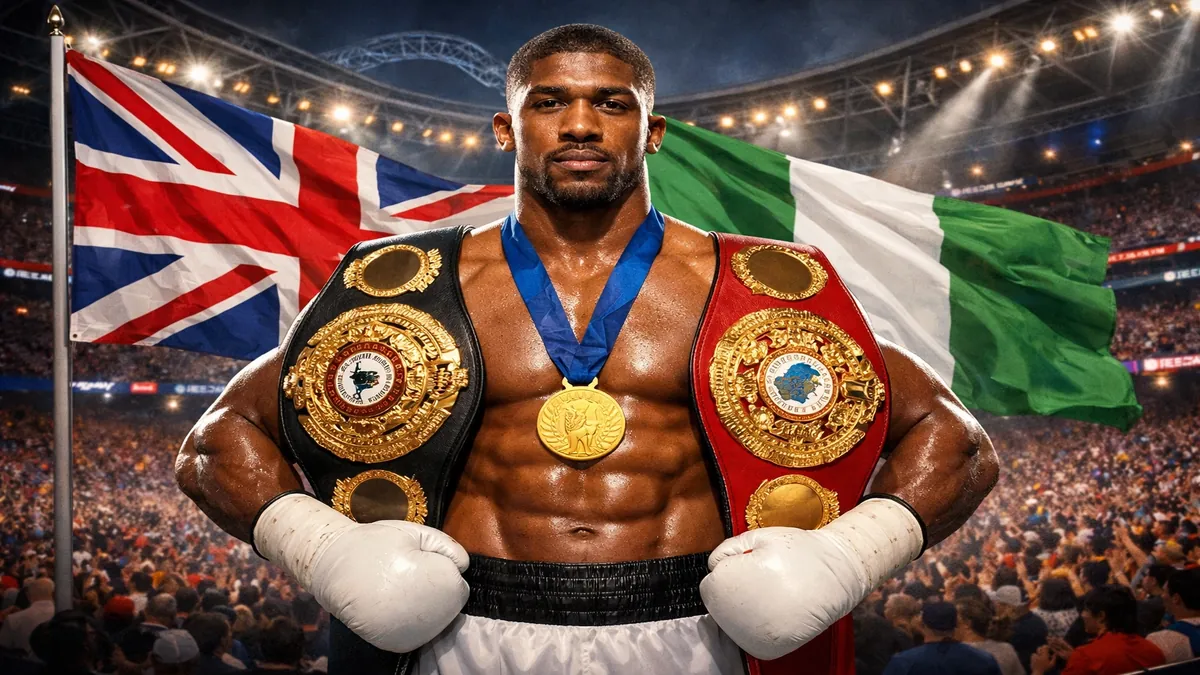
Anthony Joshua Biography: From Olympic Gold to Heavyweight Champion
Anthony Joshua is one of boxing's most commercially successful champions — a two-time unified heavyweight champion whose marketability, physical presence, and story have made him Britain's most prominent sporting figure alongside Lewis Hamilton. His career has also contained dramatic defeats that have prevented the unblemished greatness his early trajectory seemed to promise.
Early Life

Anthony Oluwafemi Olaseni Joshua was born on October 15, 1989, in Watford, Hertfordshire, England, to Nigerian parents of Yoruba heritage. He spent time in Nigeria as a child before returning to England. His early years were not boxing-focused — he was a talented footballer and athlete but only discovered boxing in his late teens.
His cousin, Ben Ileyemi, was a professional boxer who introduced Joshua to the sport at 18. The progression was remarkable: within four years of putting on gloves, Joshua would win an Olympic gold medal.
2012 Olympic Gold
Joshua's amateur career was compressed into just three years but produced exceptional results. He reached the final of the 2012 London Olympics super heavyweight division and defeated Italian Roberto Cammarelle to win gold — on home soil, at the Olympic Games, in front of a roaring British crowd at the ExCeL arena.
The victory was all the more dramatic because Cammarelle, the defending champion, appeared to be winning on points with seconds remaining. Joshua landed a combination that shifted the scorecards. The scenes — Joshua on one knee celebrating in the ring while the crowd erupted — became one of the defining images of the London Games.
Professional Career and Rise to Champion

Joshua signed with promotional company Matchroom Sport and turned professional in October 2012. His physical attributes were immediately imposing: 6'6" (198 cm), approximately 245 pounds of obvious muscle, with athleticism unusual for a heavyweight.
His knockouts were spectacular. He won his first 16 professional fights by KO, including stopping David Price in two rounds in a fight that confirmed his serious professional credentials.
IBF Heavyweight Title (2016): Joshua defeated Charles Martin in two rounds to win his first world title. The fight was less impressive than the title suggested — Martin was an undistinguished champion — but the title was real.
vs. Wladimir Klitschko (2017): The fight that confirmed Joshua's greatness — one of the best heavyweight championship fights in years. Klitschko knocked Joshua down in the sixth round. Joshua, perhaps too hurt to think clearly, abandoned his boxing and went toe-to-toe with the Ukrainian. The exchange, paradoxically, hurt Klitschko more. Joshua knocked him down three times before the referee stopped the fight in the 11th.
Wembley Stadium, 90,000 people. The night made Joshua a global star.
The Ruiz Disasters
Andy Ruiz Jr. I (June 2019): Perhaps the most shocking heavyweight upset since Buster Douglas. Ruiz, a rotund Mexican-American fighter brought in as a late replacement, knocked Joshua down four times and claimed his titles by technical knockout.
Joshua appeared confused and disconnected after the first knockdown — either he was hurt more seriously than observed, or the psychological shock of going down for the first time affected his judgment. He was stopped in the seventh round.
Andy Ruiz Jr. II (December 2019): The rematch in Diriyah, Saudi Arabia, saw Joshua fight an entirely different fight — clinching, moving, boxing from distance, avoiding exchanges. He won a unanimous but unsatisfying decision, reclaiming his titles through discipline if not dominance.
The Usyk Losses
Oleksandr Usyk I (September 2021): Usyk, a former undisputed cruiserweight champion who had moved to heavyweight, outboxed Joshua comprehensively over 12 rounds. His superior footwork, boxing intelligence, and punch selection gave Joshua no answers.
Oleksandr Usyk II (August 2022): Joshua came in heavier and more aggressive but was still outboxed and stopped in the ninth round.
Assessment
Joshua's career contains genuine greatness — the Olympic gold, the Klitschko fight, the commercial success — alongside vulnerability to elite technical boxers (both Usyk fights) and to adversity (the Ruiz knockdowns). He has the physical tools to be an all-time great; the question of whether his mental approach to adversity matches his physical gifts remains the defining question of his career.