Andy Murray Biography: Britain's Greatest Tennis Champion
Andy Murray is the greatest British tennis player of all time and one of the most compelling figures in the history of the sport. His story encompasses triumph, heartbreak, injury, and one of the most remarkable comeback narratives in sporting history.
Early Life: Dunblane and Glasgow

Andrew Barron Murray was born on May 15, 1987, in Glasgow, Scotland. He grew up in Dunblane, a small town in Stirlingshire that would tragically become known worldwide in 1996 when a gunman killed 16 children and a teacher at Dunblane Primary School. Murray, then eight years old, was in the school that day, hiding in a classroom with teacher Ron McCombes. The experience left an indelible mark on him.
Murray's mother, Judy Murray, is a former professional tennis player and one of Scotland's most prominent coaches. Tennis was not so much a choice as an environment — he grew up with racquets in hand, competing alongside his older brother Jamie, who would become a world-class doubles player.
Junior Career
Murray's talent was evident early. He won the Orange Bowl (one of the most prestigious junior tournaments) in 2004 and was ranked the world's top junior player. His game — built on exceptional defense, brilliant returning, and sharp tactical intelligence — was already taking shape.
He declined a scholarship offer from Barcelona FC's football academy as a teenager (he was a talented footballer as well as tennis player) and committed to tennis full-time, training in Barcelona at the Schiller Academy.
Early Professional Career

Murray turned professional in 2005 and quickly established himself. He won his first ATP title in 2006 and reached his first Grand Slam final at the 2008 US Open, losing to Roger Federer. His ability to compete with the Big Three — Federer, Nadal, and Djokovic — was already clear, but converting close losses into victories would be a defining challenge of his early career.
He went through a period of near-misses that was difficult to watch. Four Grand Slam final losses — each one against the highest quality opposition — tested his mental resilience and sparked widespread public debate in Britain about whether he would ever win the major title his talent merited.
US Open 2012: The Breakthrough
At the 2012 US Open, Murray finally claimed his first Grand Slam title, defeating Novak Djokovic in five sets. The relief was immense — for Murray, for his team, and for British tennis. He became the first British man to win a Grand Slam singles title since Fred Perry in 1936.
Few sporting droughts had lasted as long and been as heavily scrutinized. Murray ended it with characteristic determination.
Wimbledon 2013: History Made
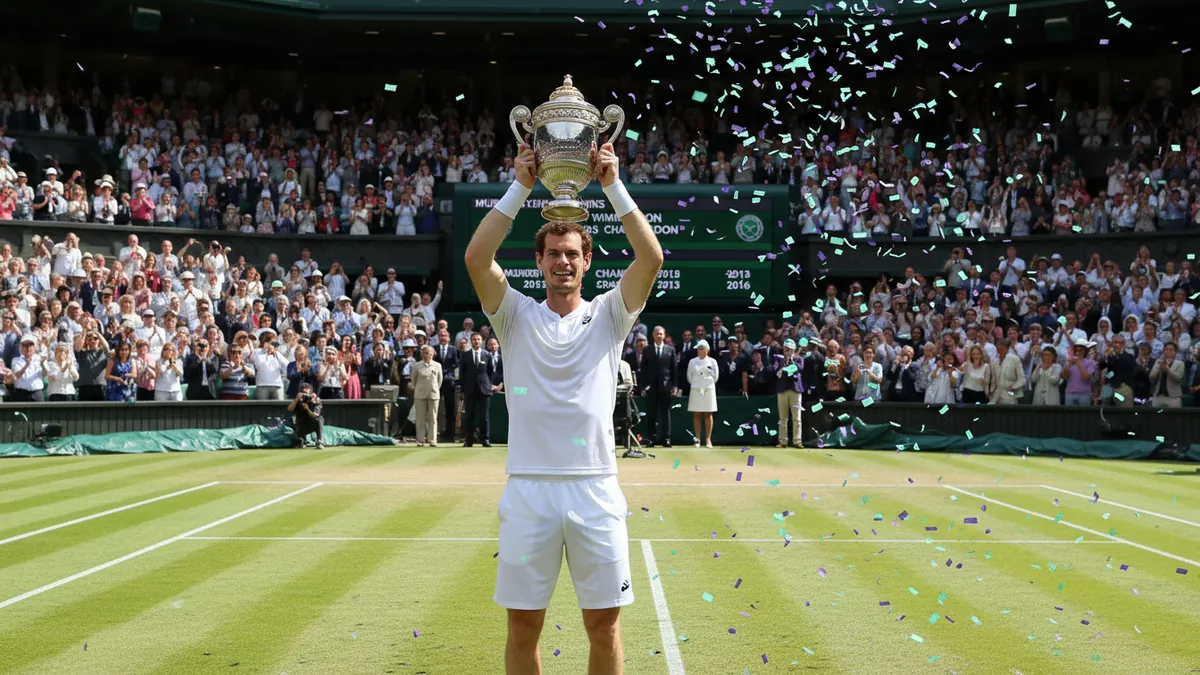
If the US Open was relief, Wimbledon 2013 was something else entirely. Murray defeated Djokovic in straight sets to become the first British man to win Wimbledon since Perry in 1934 — a 77-year wait.
The scenes on Centre Court were extraordinary. The crowd at the All England Club, not typically demonstrative, sang, cheered and wept. Prime Minister David Cameron was present. The weight of national expectation, finally released, created one of the great emotional scenes in British sport.
Murray won Wimbledon again in 2016, further cementing his status as the home crowd's champion.
Olympic Glory
Murray won Olympic gold at London 2012 (defeating Federer in a rematch of the Wimbledon final just weeks earlier) and defended his title at Rio 2016. His two Olympic gold medals are arguably the most decorated Olympic tennis achievement of his era, given the extraordinary standard of competition.
He is one of very few players to have defended an Olympic singles title. The achievement is often undervalued given the brilliance of his Grand Slam record.
World No. 1
In November 2016, Murray reached world No. 1 for the first time, becoming only the second British man ever to hold the ranking. He ended 2016 as the year-end No. 1, completing one of the finest seasons in recent ATP history.
Hip Injury and Comeback
A hip injury began affecting Murray in 2017 and progressively worsened. By the 2019 Australian Open, he was in such pain he publicly spoke about potential retirement at his pre-tournament press conference in tears. The image of one of sport's toughest competitors visibly broken was harrowing.
He underwent a pioneering metal-on-metal hip resurfacing operation — a procedure that had never been successfully performed on an elite tennis player before. Surgeons essentially rebuilt his hip.
What followed was one of the great sporting comebacks. Murray returned to the ATP Tour, initially at doubles and then singles. By 2021–2023 he was winning ATP matches again, competing at Grand Slams, and occasionally defeating top-10 players — all with a metal hip.
Playing Style and Legacy
Murray's game is built on defense, anticipation, and mental fortitude. His return of serve is among the best in ATP history. His ability to retrieve seemingly impossible balls and turn defense into offense is legendary.
His legacy extends beyond trophies. He has been a prominent advocate for women's issues in tennis — becoming the first male player to hire female coaches (in his case, Amélie Mauresmo) and being consistently outspoken about pay equality. He was awarded an OBE and subsequently a knighthood, becoming Sir Andy Murray.
Retirement
Andy Murray retired from professional tennis in 2024 at the Paris Olympics — a fitting farewell to a career that had bookended two Olympic appearances in the French capital. He leaves as Britain's greatest tennis player, a three-time Grand Slam champion, and one of the sport's most admired figures.