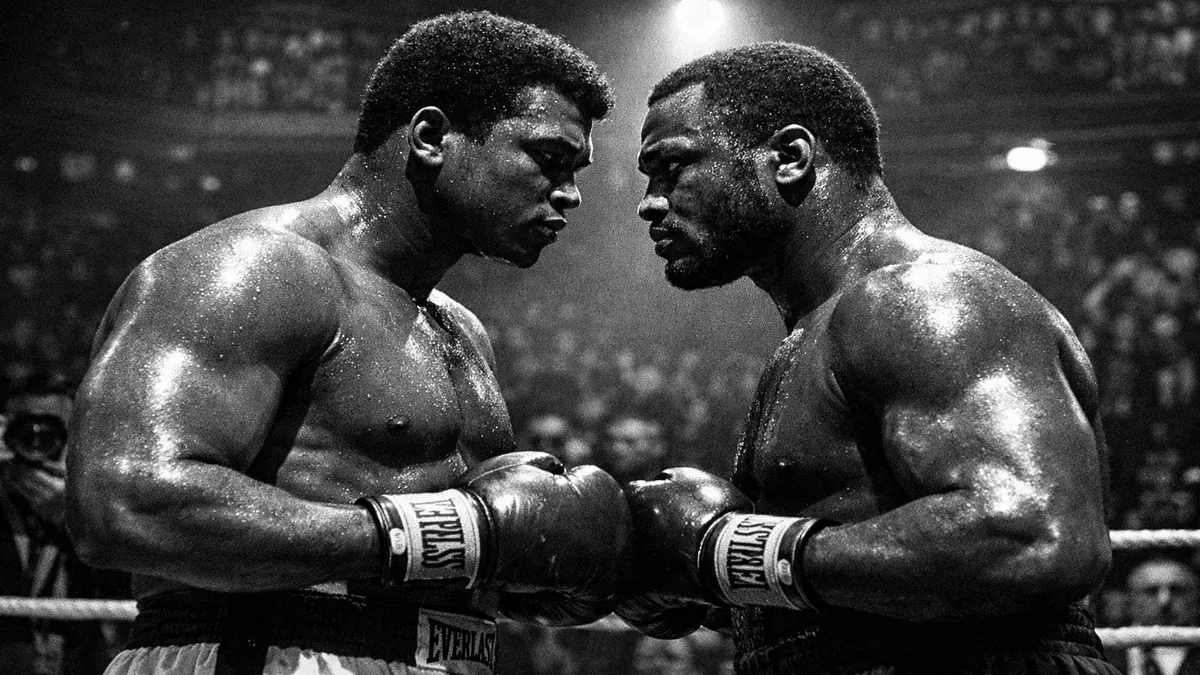
Ali vs. Frazier: The Greatest Rivalry in Boxing History
Muhammad Ali versus Joe Frazier is the defining rivalry of boxing's golden era — three fights of extraordinary brutality and drama between two champions of entirely different styles and temperaments, set against the turbulent backdrop of 1970s America.
The Context: Two Champions, One Title

When Muhammad Ali was stripped of the heavyweight championship and banned from boxing in 1967 for refusing Vietnam draft induction, Joe Frazier won the vacant title by defeating Buster Mathis. Frazier, unlike many athletes of his era, spoke publicly in support of Ali's right to box — a generosity Ali would later repay poorly.
When Ali returned in 1970, a collision with Frazier was inevitable. Both men were undefeated. Both had legitimate claims to be heavyweight champion. Both were among the greatest fighters of their era. What they represented, in American cultural terms, could not have been more different.
The Fighters
Muhammad Ali was the antiwar, draft-resisting, Nation of Islam-converted fighter whose political stances had divided the country. He was the poetic, dancing, taunting showman — beautiful to watch, culturally omnipresent.
Joe Frazier was the blue-collar, churchgoing son of a South Carolina sharecropper who had moved to Philadelphia and built his career through relentless training and ferocious determination. He was an introvert compared to Ali, a man who let his fists speak.
Ali's cruel psychological campaign against Frazier — calling him "gorilla," "Uncle Tom," and suggesting he was the white establishment's fighter — caused Frazier genuine pain. "I want to kill him," Frazier would say, and those who knew him believed it was not entirely metaphorical.
Fight I: "The Fight of the Century" (March 8, 1971)

Madison Square Garden, New York City
Result: Frazier wins by unanimous decision (15 rounds)
The first Ali-Frazier fight was the most anticipated sporting event of its era. Both men were undefeated, both had legitimate claims to the heavyweight championship, and the cultural stakes could not have been higher.
Ali entered the ring in red velvet trunks, dancing and taunting. Frazier came to fight. The pattern was immediate: Ali circled, threw combinations, and tried to keep distance. Frazier pressured relentlessly, his left hook probing for the opening.
For the first several rounds, Ali controlled the fight. But Frazier's pressure gradually wore Ali down, and in the 11th round Frazier's body work began to show its effect. The most dramatic moment came in the 15th round: Frazier's enormous left hook crashed against Ali's jaw, putting him on the canvas for the first time in his professional career.
Ali rose and finished the round, but the knockdown sealed the decision. Frazier won unanimously in one of boxing's greatest fights. Both men required hospitalization afterward — Frazier's condition was so serious that his team kept it private for days.
Fight II (January 28, 1974)
Madison Square Garden, New York City
Result: Ali wins by unanimous decision (12 rounds)
The rematch was less dramatic but significant. Held without a championship on the line (Foreman held the title by then), it was nonetheless a massive event. Ali had refined his approach — more combination punching, more lateral movement. He controlled the fight and won the decision clearly.
This victory set the stage for Ali's challenge to Foreman (the Rumble in the Jungle) and Frazier's own continued career.
Fight III: "The Thrilla in Manila" (October 1, 1975)
Araneta Coliseum, Quezon City, Philippines
Result: Ali wins when Frazier's corner retires him before Round 15
The third fight is considered one of the greatest and most brutal in boxing history. Held in the Philippines at the direction of promoter Don King and Ferdinand Marcos's government, it was staged in crippling heat — reported at over 40°C (105°F) inside the arena.
Ali came out fast, taunting and landing combinations. Frazier's left eye began swelling in the early rounds. But around the 10th round, the momentum shifted: Frazier's pressure began telling, and Ali looked tired, retreating to the ropes. Between rounds, Ali told his trainer Angelo Dundee to cut off his gloves — he wanted to stop. Dundee refused.
Then Frazier's eye worsened. Unable to see properly from his left side, he was taking clean shots he couldn't see coming. Eddie Futch, Frazier's trainer and one of the wisest men in boxing, made the decision before the 15th round: "Joe, I'm going to stop it."
Frazier protested furiously. Futch's response — "Sit down, son. It's all over. No one will ever forget what you did here today" — is among boxing's most memorable exchanges.
Ali, when informed the fight was over, collapsed in his corner. "That was the closest thing to dying that I know of," he said afterward.
Aftermath
The Ali-Frazier wars destroyed both men physically. The accumulated damage of those three fights contributed to Ali's Parkinson's syndrome and to Frazier's health issues in his later years.
Their personal relationship never fully recovered. Frazier retained bitterness about Ali's mockery until near the end of his life. Ali's later expressions of regret about how he treated Frazier came too late for the wounds to fully heal.
Joe Frazier died in November 2011 of liver cancer. Muhammad Ali survived him by nearly five years, dying in June 2016.
Legacy
Ali vs. Frazier is boxing's greatest rivalry — three fights of extraordinary quality and courage, set within one of the most culturally significant periods in American history. No subsequent boxing rivalry has matched it for the combination of athletic excellence, personal drama, and broader cultural meaning.