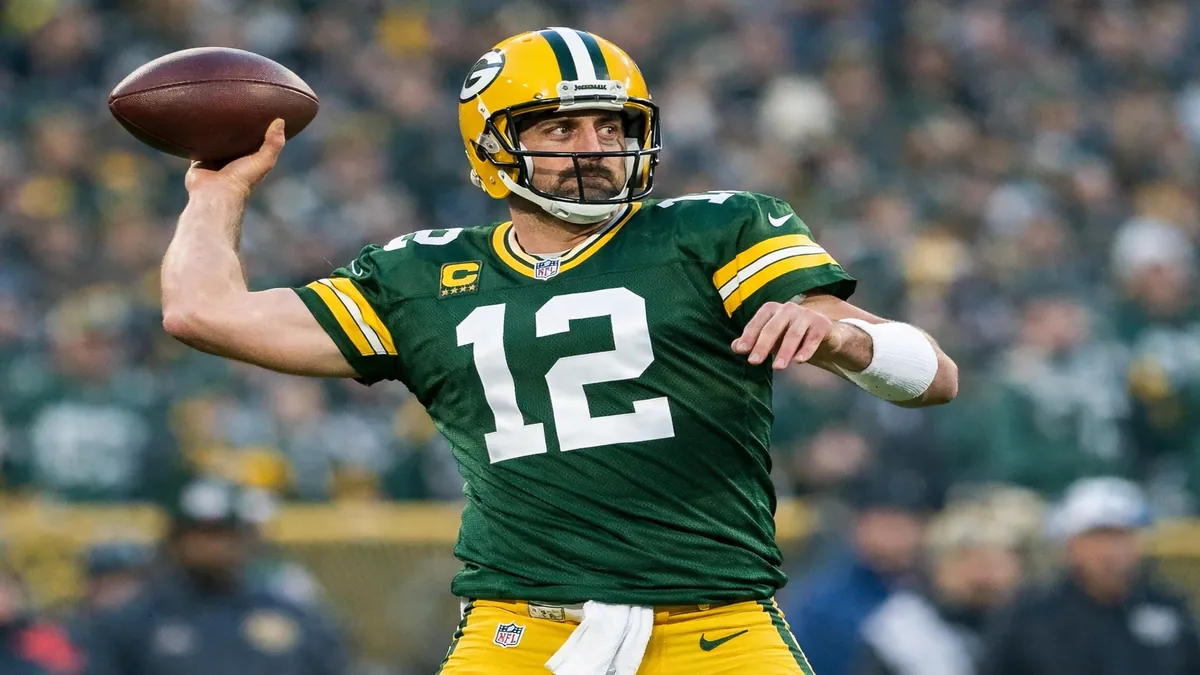
Aaron Rodgers Biography: The Master of the Modern NFL Quarterback
Who Is Aaron Rodgers? (intro)

Aaron Rodgers is an iconic figure in the National Football League, widely celebrated as one of the most talented and statistically dominant quarterbacks of his generation, and arguably of all time. Known for his unparalleled arm talent, exceptional accuracy, and uncanny ability to extend plays, Rodgers has redefined the quarterback position with his blend of precision passing and improvisational brilliance. His career, primarily spent with the Green Bay Packers, is marked by a Super Bowl championship, multiple MVP awards, and a consistent demonstration of elite-level play that has captivated fans and frustrated opposing defenses for nearly two decades. Rodgers is not just a quarterback; he is a maestro of the gridiron, orchestrating offenses with a rare combination of physical gifts and mental acuity.
Rodgers" journey to NFL stardom is a testament to perseverance and a relentless pursuit of excellence. Overcoming a less-than-traditional path to the NFL, he blossomed into a player whose highlights often defy belief, showcasing throws from impossible angles and an almost telepathic connection with his receivers. His impact extends beyond the stat sheet; he has been a cultural touchstone for the Packers franchise, embodying a tradition of quarterbacking excellence that stretches back to legends like Bart Starr and Brett Favre. As he transitioned to the New York Jets later in his career, the anticipation surrounding his ability to elevate a new franchise underscored his enduring influence and star power in the league.
Early Life and Background
Aaron Charles Rodgers was born on December 2, 1983, in Chico, California. Growing up, Rodgers was immersed in sports, with his father, Edward Rodgers, having played football as an offensive lineman for the Chico State Wildcats. This athletic background instilled in Aaron a competitive spirit and a deep understanding of the game from an early age. However, unlike many future NFL stars, Rodgers did not receive widespread attention from major college football programs during his high school years.
He attended Pleasant Valley High School in Chico, where he played quarterback. Despite his talent, his relatively small stature at the time and the lack of a dominant high school program meant that he was largely overlooked by Division I recruiters. This early setback would become a defining characteristic of his career, fueling a drive to prove himself at every level. His path to collegiate football was unconventional, beginning at a community college, a journey that would ultimately shape his resilience and determination.
Early Career / College / Amateur Career

Rodgers" collegiate journey began at Butte Community College in Oroville, California. This was a pivotal period for him, as it allowed him to develop physically and mentally without the immediate pressure of a Division I program. In his single season at Butte in 2002, Rodgers led the Roadrunners to a 10-1 record, a NorCal Conference championship, and a No. 2 national ranking. His impressive performance, which included throwing for 2,400 yards and 28 touchdowns, caught the attention of scouts from the University of California, Berkeley.
In 2003, Rodgers transferred to Cal (University of California, Berkeley), where he quickly ascended to the starting quarterback position. Despite his relative inexperience at the Division I level, he showcased his exceptional talent, leading the Golden Bears to a 7-5 record in his first season. His junior year in 2004 was particularly outstanding; he guided Cal to a 10-2 record, a No. 4 national ranking, and a berth in the Holiday Bowl. During his time at Cal, Rodgers set school records for lowest single-season and career interception rates, demonstrating the precision and decision-making that would become hallmarks of his NFL career. He finished his Cal career with 5,469 passing yards, 43 touchdowns, and only 13 interceptions. Despite his success, he was famously passed over by several teams in the 2005 NFL Draft, falling to the Green Bay Packers as the 24th overall pick, a moment that would forever be etched into NFL draft lore.
Professional Career — Green Bay Packers: The Apprenticeship and Ascent to Stardom (2005–2010)
Aaron Rodgers" NFL career began under the immense shadow of Brett Favre, the legendary Green Bay Packers quarterback. Drafted in 2005, Rodgers spent his first three seasons as Favre"s understudy, a period that was both challenging and invaluable for his development. During this time, he meticulously studied Favre"s approach to the game, while also refining his own mechanics and understanding of the Packers" offensive system. The apprenticeship was not without its frustrations, as Rodgers yearned to play, but it ultimately prepared him for the monumental task of succeeding a franchise icon.
In 2008, Favre retired (briefly) and Rodgers was finally handed the reins as the Packers" starting quarterback. The transition was seamless, as Rodgers immediately demonstrated that he was more than capable of leading the team. In his first season as a starter, he threw for over 4,000 yards and 28 touchdowns, showcasing his arm strength and accuracy. Over the next two seasons, he continued to improve, leading the Packers to playoff appearances and establishing himself as one of the league"s premier quarterbacks. His ability to make all the throws, combined with his mobility and poise, quickly earned him the respect of his peers and the adoration of the Packers faithful.
Professional Career — Super Bowl XLV and MVP Seasons (2010–2014)
The pinnacle of Aaron Rodgers" early career came in the 2010 season, culminating in a dominant run through the playoffs and a victory in Super Bowl XLV. Despite entering the playoffs as a sixth seed, Rodgers led the Packers to three road victories before defeating the Pittsburgh Steelers 31-25 in the Super Bowl. Rodgers" performance in the championship game was masterful, as he threw for 304 yards and three touchdowns, earning the Super Bowl MVP award. This victory solidified his status as an elite quarterback and brought the Lombardi Trophy back to Green Bay.
Following his Super Bowl triumph, Rodgers embarked on a period of unprecedented individual dominance. In the 2011 season, he delivered one of the greatest statistical seasons by a quarterback in NFL history, throwing for 4,643 yards, a then-career-high 45 touchdowns, and an astonishingly low 6 interceptions. His passer rating of 122.5 remains an NFL single-season record. For his efforts, Rodgers was awarded his first NFL MVP award. He continued his elite play, earning his second MVP award in 2014, where he threw for 38 touchdowns against just 5 interceptions. During this period, Rodgers was widely considered the best quarterback in the league, known for his ability to make seemingly impossible throws and his incredible efficiency.
| Season | Team | Games | Comp | Att | Pct | Yards | TDs | INT | Rating |
|---|---|---|---|---|---|---|---|---|---|
| 2010 | GB | 15 | 312 | 475 | 65.7 | 3,922 | 28 | 11 | 101.2 |
| 2011 | GB | 15 | 343 | 502 | 68.3 | 4,643 | 45 | 6 | 122.5 |
| 2012 | GB | 16 | 371 | 552 | 67.2 | 4,295 | 39 | 8 | 104.1 |
| 2013 | GB | 9 | 193 | 281 | 66.6 | 2,536 | 17 | 6 | 104.9 |
| 2014 | GB | 16 | 341 | 520 | 65.6 | 4,381 | 38 | 5 | 112.2 |
| Season | Team | Games | Comp | Att | Pct | Yards | TDs | INT | Rating |
| 2015 | GB | 16 | 347 | 572 | 60.7 | 3,821 | 31 | 8 | 92.7 |
| 2016 | GB | 16 | 401 | 610 | 65.5 | 4,428 | 40 | 7 | 104.2 |
| 2017 | GB | 7 | 154 | 238 | 64.7 | 1,675 | 16 | 6 | 97.2 |
| 2018 | GB | 16 | 372 | 597 | 62.3 | 4,442 | 25 | 2 | 95.4 |
| 2019 | GB | 16 | 353 | 569 | 62.0 | 4,002 | 26 | 4 | 95.4 |
| 2020 | GB | 16 | 372 | 526 | 70.7 | 4,299 | 48 | 5 | 121.5 |
| 2021 | GB | 16 | 366 | 531 | 68.9 | 4,115 | 37 | 4 | 111.9 |
| 2022 | GB | 17 | 350 | 542 | 64.6 | 3,695 | 26 | 12 | 91.1 |
| Team | Years | Games | Comp | Att | Pct | Yards | TDs | INT | Rating |
| Green Bay Packers | 2005–2022 | 190 | 5,001 | 7,661 | 65.3 | 59,055 | 475 | 105 | 103.6 |
| New York Jets | 2023–Present | 1 | 0 | 0 | 0.0 | 0 | 0 | 0 | 0.0 |
| Career Totals | 19 Seasons | 191 | 5,001 | 7,661 | **65.3 | 59,055 | 475 | 105 | 103.6 |
Note: Statistics for the New York Jets reflect only the 2023 season where he played only 1 game before injury. His career totals are as of the end of the 2023 season.
These numbers place Rodgers among the all-time leaders in passing yards and touchdowns, with an exceptionally low interception rate, highlighting his remarkable efficiency and care for the football.
Personal Life
Aaron Rodgers" personal life has often been a subject of public interest, particularly his relationships and his outspoken views on various topics. He has been involved in high-profile relationships with actresses and has maintained a relatively private personal life despite his celebrity status. Rodgers is known for his intellectual curiosity and has often discussed his interests in philosophy, history, and alternative health practices.
He has also been actively involved in philanthropy, particularly through the Aaron Rodgers Charity Fund and his work with various organizations focused on children"s health and well-being. His commitment to giving back to the community, especially in Green Bay, has been a consistent aspect of his public persona. His move to New York has brought new attention to his personal life, but he continues to balance his public role with a desire for privacy.
Legacy and Impact
Aaron Rodgers" legacy is one of a quarterback who mastered the art of efficiency and improvisation, setting new standards for accuracy and playmaking. He demonstrated that a quarterback could be both a meticulous technician and a daring artist, capable of executing complex schemes while also creating magic out of broken plays. His influence on the modern NFL quarterback is profound, as many young passers now strive to emulate his ability to extend plays and deliver accurate throws on the move.
He will be remembered for his incredible arm talent, his ability to win MVP awards at an advanced age, and his unwavering commitment to excellence. While some may point to his single Super Bowl victory as a potential asterisk on his legacy compared to other all-time greats, his individual brilliance and statistical dominance are undeniable. Rodgers has left an indelible mark on the Green Bay Packers franchise, leading them through a period of sustained success and providing countless memorable moments. His career with the Jets, though brief so far, represents a new chapter in a legacy that will undoubtedly place him in the Pro Football Hall of Fame as one of the most gifted quarterbacks to ever play the game.
Conclusion
Aaron Rodgers" biography is a compelling narrative of a quarterback who defied expectations, honed his craft, and ascended to the pinnacle of the NFL. From his overlooked high school days to his apprenticeship under Brett Favre and his eventual emergence as a Super Bowl champion and multiple MVP winner, Rodgers has consistently showcased a rare blend of talent, intelligence, and competitive fire. His revolutionary playing style, characterized by unparalleled accuracy and improvisational genius, has left an enduring impact on the game, influencing a generation of quarterbacks. As he continues his career with the New York Jets, Rodgers remains a captivating figure, a testament to the power of perseverance and the pursuit of perfection. His legacy is secure as one of the greatest to ever grace the gridiron, a true master of the modern NFL quarterback position.